Blog
Referral Marketing ConceptsReferral Program Ideas
4 Key Funnel Metrics from 400 Referral Programs
Chris Duskin

Products
Enterprise platform
Platform features
Acquisition programs
Retention programs
Learn
Resources
Developers
Documentation
SDKs & GitHub
Blog
Chris Duskin
Updated August 2026 We analyzed 400 companies that use our referral platform to power their programs across a wide range of industries including retail, financial services, home services, and telecom. All of these companies have engineered programs—through iteration and optimization—that amplify word-of-mouth and reliably drive more sales over the long term. Here are the numbers we saw at every stage of the referral funnel, and here's how you can take their learnings and use them to improve your own referral program.
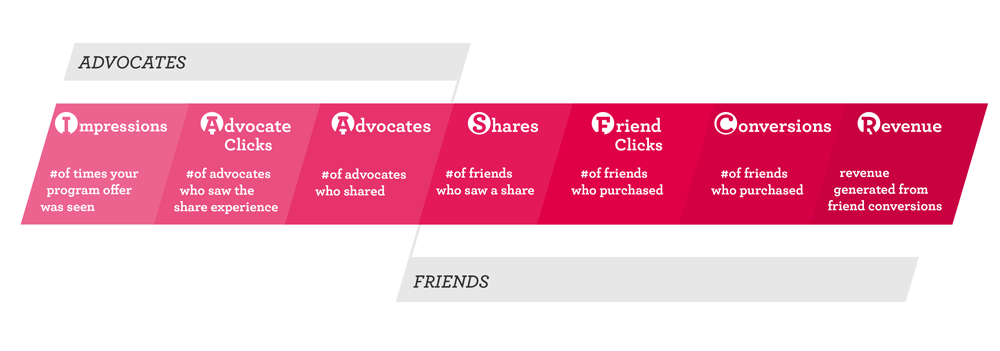 The referral funnel describes the process from the very first step of showing a current customer a referral call-to-action (CTA), which we call the impressions stage, to the final step, getting a sale from a referred friend, or the revenue stage. There are two distinct funnels within the referral funnel:
The advocate funnel is all about how many advocates share (Advocacy Rate), how much they share (Share Rate), and the size of the audience they reach.
The share message that comes from the advocate and is delivered to the friend is the bridge connecting the two funnels.
The friend funnel captures how many friends click on advocate shares (Friend Clickthrough Rate) and then ultimately convert (Friend Click).
Your advocacy rate is the percentage of advocates who share your referral offer when presented with the opportunity to do so. Advocates are the beating heart of your referral program. An advocate is someone who has recommended your brand to a friend at least once. The typical advocate journey looks like an advocate viewing your referral CTA somewhere on your homepage, clicking on it to get more information, then deciding whether or not to share their personal referral code with friends. Your advocacy rate is the primary metric you should track to gauge the effectiveness of your advocate funnel. For Extole customers, the median advocacy rate sits at around 19%.
Making your referral program easier to find and navigate is the best way to improve you advocacy rate. These best practices can help you design a referral experience that is seamless for customers:
In addition to designing a seamless advocate share experience, you can use A/B testing to find what your advocates respond to most. Test and iterate different marketing copy, rewards, and reward structures to drive advocacy.
Your share rate is the average number of unique shares per advocate. At Extole, we've seen this to be around 2 shares per advocate. If that number seems low, keep in mind it's partly because about 20% of your advocates drive 80% of your referral program, which skews the average down.
Two shares per advocate is a reasonable baseline for a healthy referral program, but "good" is highly relative to your industry, your incentive structure, and how aggressively you're nurturing your advocate base. A program that makes sharing frictionless, rewards both sides of the transaction, and actively surfaces the referral CTA at high-intent moments will consistently outperform one that buries the experience. The number to watch isn't just the average—it's the trend. A share rate that's climbing over time is a signal that your program design and promotion are working. A flat or declining share rate is an early warning sign worth investigating before it shows up downstream in conversions. It's also worth separating your share rate by channel. Email and social shares behave very differently, and a blended average can obscure where your real opportunity lies. Programs that give advocates multiple ways to share—and make each channel easy to use—tend to see higher overall share rates than those that rely on a single path to referral.  The 80-20 distribution resembles the Power Law, in which a small number of people drive the vast majority of positive outcomes. In this case, some of your advocates might share once and then forget about it completely—others might refer to it all the time. We call the latter "super advocates", and they have made advocacy of your product a habit.
To make the most of the power rule, run targeted campaigns designed specifically for super advocates.
If you're looking to build up your advocate base, consider doing the following.
Your friend clickthrough rate (CTR) is the % of friends who click per share. If 50/100 people clicked on a share link, for example, Friend CTR would be 50%. This number tends to be pretty high, with the median at around 10% for referral programs powered by Extole. With friend CTR, it's vital that you look at benchmarks for high traffic distribution channels—specifically email and messaging. Some channels have consistently higher share rates than others, though this can vary across businesses. Monitor your CTR by channel to determine where your customers are most likely to click on a share link, and apply targeted strategies to improve each channel's CTR.
Simply put, if you don't let your customers personalize their share to their friends, you're missing out on the true power of referral. Much of what will determine whether the friend clicks through is decided in the previous step by the advocate. The more the referral share is personalized and tailored to the person receiving it and the channel in which it appears, the more effective it will be.
Your friend conversion rate is calculated by taking the number of friends who complete a qualifying action, such as making a purchase or opening an account, and dividing it by the total number of friends who clicked on an advocate share link. You might think that friend conversion rates would be high once a customer has already clicked through to a landing page, but this is not always the case. For some beauty online retailers, for example, the friend conversion rate can be as low as 2.9%. That amounts to a huge wasted opportunity where a friend's clearly expressed interest has been squandered. In contrast, among Extole customers, we see conversion rates of approximately 13%, which is 4x the conversion rate of the general population.
What's most important at this stage in the funnel is user experience design. The logic is simple—make it easy to redeem the reward and buy the product, and you'll boost your conversion rates and turn more friends into customers. Here are some best practices for designing a friend landing page:
Don't neglect the mobile friend landing experience. If your friend CTR is high but your friend conversion rate is low, it could be that the mobile experience is clunky and hard to navigate. Here are some things to consider:
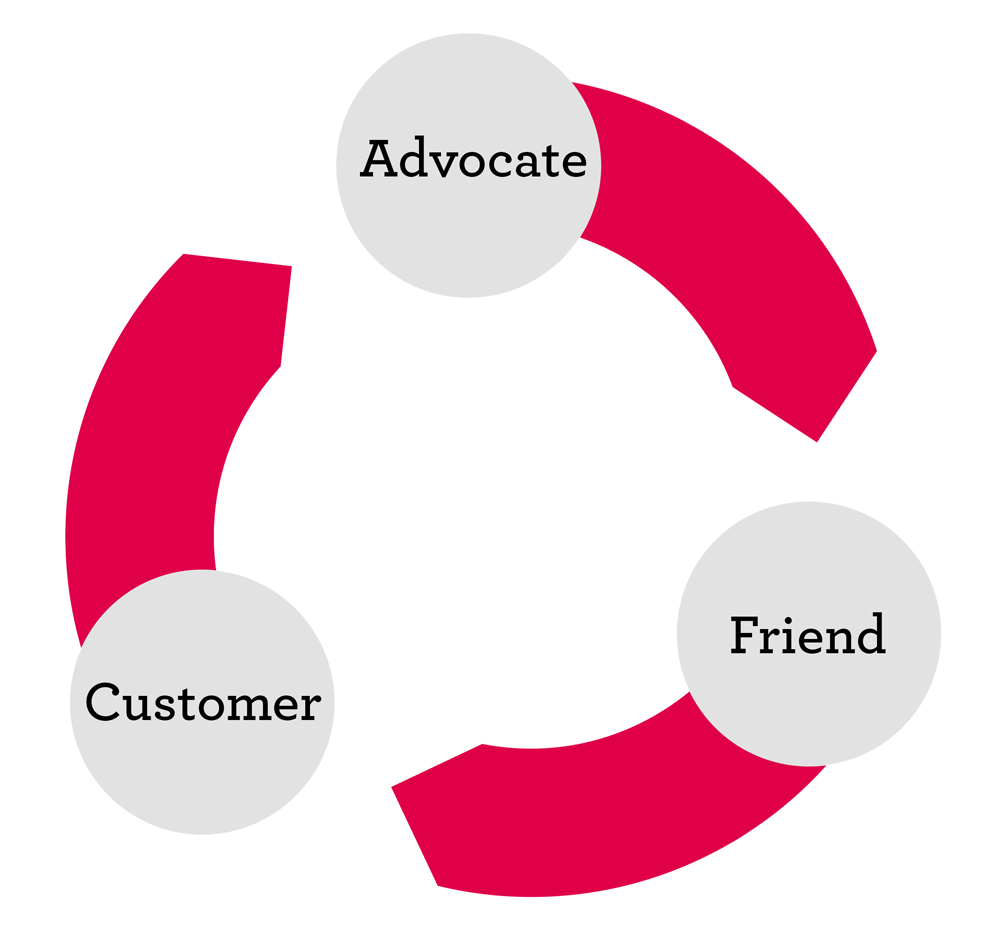 The referral flywheel is the end of the referral funnel—or is it? The beauty of referral is that the buck doesn't stop with conversion. Brands that use Extole find that their referred customers refer much more often—up to 5x more often than non-referred customers. What you end up with looks less like a funnel and more like a flywheel. Improving and refining the referral process creates more advocates, who refer more friends, who become customers, who then become advocates and share at a much higher rate. You're not likely to end up with a massively viral growth channel—but by putting in the hard work to improve each of these 4 key referral metrics, you'll create a strong foundation of systematized word-of-mouth that will pay dividends across every single one of your acquisition channels. Book a demo to learn more about how Extole powers referral programs for B2C brands.
The median advocacy rate across 400 referral programs is 19%, meaning roughly one in five customers who see a referral call-to-action will share it with friends.
Most advocates share with about 2 people on average, though 20% of advocates drive 80% of total shares, creating a power law distribution where super advocates refer significantly more often.
Friend conversion rates average around 13% for optimized referral programs, which is 4x higher than the 2.9% conversion rate seen in poorly designed programs that create friction in the redemption process.
The median friend clickthrough rate is approximately 100%, with Facebook shares reaching 80% and email shares around 55%, meaning each share typically generates at least one click from the advocate's network.

Amazon’s referral program, previously only to be found buried deep inside settings, is now being presented as an ad to Amazon shoppers inside of the mobile app, encouraging them to refer their friends.
They're they go again. Amazon has now kicked your marketing plan square in the teeth. Remember today.
Advance Auto Parts acquires better customers through refer-a-friend than through its other channels. Learn 8 keys to how from Manager of Digital Marketing & Innovation Heath Bradbury.