Blog
Extole News
Introducing: The Extole MCP for Developers, Marketers, and AI Agents
Paul Davidson

Products
Enterprise platform
Platform features
Acquisition programs
Retention programs
Learn
Resources
Developers
Documentation
SDKs & GitHub
Blog
Paul Davidson
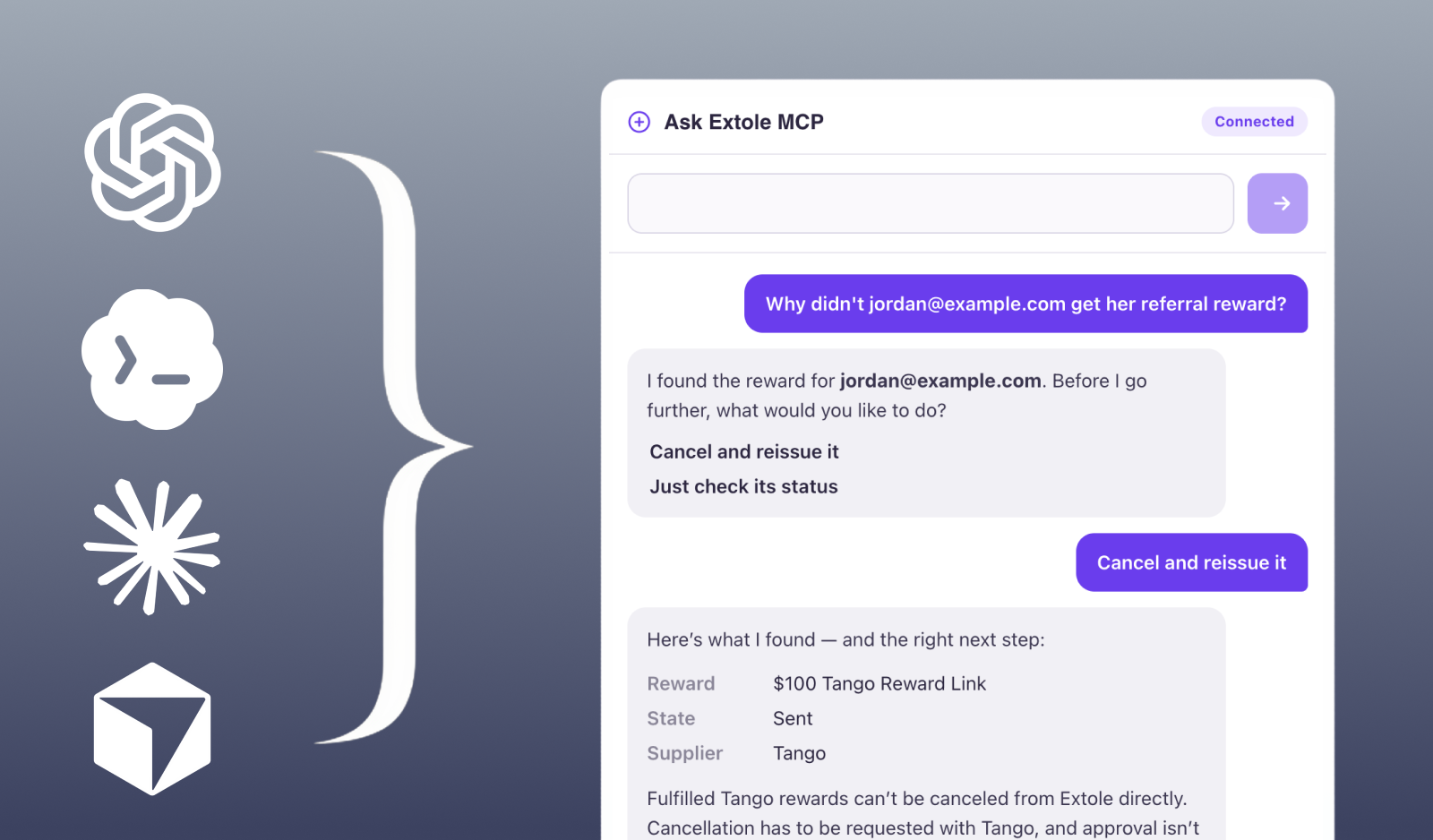
AI-enabled teams are under increasing pressure to launch more campaigns, orchestrate more complex customer journeys, and act on more data than ever before. Armed with powerful AI tools, speed and scale are within reach for enterprise engineering and marketing teams—but what many of these agentic marketing tools are missing is architecture that protects deterministic processes while still enabling AI-powered operation. That is why we are launching the Extole MCP. The Extole MCP connects Extole to any MCP-compatible AI environment — Claude, Cursor, ChatGPT, and others — giving developers, marketers, and AI agents a permissioned way to work directly with Extole’s enterprise offer management platform through the AI tools they already use. Teams can use plain language to inspect programs, retrieve data, update configurations, review participant and reward status, and operate personalized referral, reward, loyalty, and engagement programs—while Extole continues to handle the deterministic execution layer underneath. The MCP uses OAuth with scoped tokens, so your agents operate with exactly the access you grant them — no more, no less. This launch is part of a broader expansion of Extole's developer-ready platform capabilities, including APIs, SDKs, CLI tooling, and AI-accessible surfaces. Together, these capabilities make Extole more accessible to developers and AI-assisted teams building on the platform. But the MCP deserves its own spotlight because it changes how enterprise teams can operate Extole: through AI-assisted workflows that are fast, governed, auditable, and grounded in live platform data. Extole MCP is not a chatbot layered on top of a referral tool, but a new operating surface for a configurable offer management platform built for the AI era.
Extole's Model Context Protocol is the interface through which developers, marketers, and AI agents can work directly with Extole's offer management platform through the AI tools they already use, including Claude, Cursor, and ChatGPT, enabling AI-powered operations across the entire program lifecycle. In practice, this changes what is possible for the teams that work with Extole every day. A developer using an AI coding tool can inspect Extole's component structure, understand the relationships between campaigns, audiences, rules, and rewards, configure program logic, and validate an integration path before launch. A marketer can describe the program they want in plain language and use AI to help configure it without logging into My Extole. If a reward value needs to change, a program setting needs to be updated, or a participant's reward status needs to be checked, those operations are accessible through the MCP surface, enabling faster program management with fewer dependencies on engineering time.
Extole MCP exposes a defined set of read and write operations built on Extole’s published API layer. These include:
Teams can use MCP to:
For marketers and operators, this means faster answers to everyday program questions: what changed, what is active, who qualified, which rewards were issued, and how a campaign is performing.
With the right permissions, teams can also use MCP to:
These capabilities are especially valuable for teams that manage complex programs across markets, brands, segments, or business units. Instead of waiting on a ticket cycle for every change, authorized users can make controlled updates through an AI-assisted interface.
The most visible benefit of MCP is plain-language operation. A marketer can ask:
Every capability surfaced through MCP is backed by Extole's published API contracts — the same endpoints available to any integration. Extole’s newly expanded API makes the platform semantically clear, meaning an AI agent can traverse component relationships and understand what it is working with from the JSON structure itself, without requiring platform-specific training. For marketers, this translates directly to speed and self-sufficiency: fewer tickets, faster answers, and the ability to make program changes through conversation rather than navigation. For developers, it means the platform's full component model is accessible through the build environment rather than a separate portal.
Template-based referral and loyalty tools are designed for the median use case. They work well when your program fits their assumptions: a standard refer-a-friend flow, a fixed reward structure, a single audience segment, a straightforward conversion event. But in enterprise environments, those templates can become constraints. Extole is built on a component-based architecture. Rather than forcing programs into predefined flows, the platform gives developers and product teams reusable building blocks: events, audiences, rules, offers, rewards, messages, journeys, integrations, and reporting. Each component is configurable and can be combined with others in ways that reflect your business logic. This architecture supports program types that a standard referral tool cannot accommodate:
The platform's event-driven architecture sits underneath all of it. Behavioral events arrive from web, mobile, APIs, batch systems, CRMs, CDPs, commerce platforms, and integrations. Those events flow through configurable campaigns, eligibility and fraud rules, reward authorization logic, and into fulfillment. The participant profile records every outcome and feeds subsequent events, so personalization becomes more accurate over time.
The most important architectural decision behind Extole MCP is also the least visible to the end user: where AI operates and where Extole takes over. AI belongs in the configuration and validation layer. That is where it adds the most value: helping teams draft program structures, inspect component relationships, identify configuration gaps, and move faster from intent to launch. It is fast, flexible, and well-suited to tasks where iteration is cheap and correction is easy. What AI cannot own is the runtime execution layer—eligibility decisions, fraud detection, reward authorization, and fulfillment. These are not tasks where probabilistic reasoning is an acceptable tradeoff—a priority reflected in AI governance spending reaching $492 million in 2026. When a reward has real financial value, the system that authorizes it must be deterministic. Extole enforces this boundary by design. When an AI agent operates through Extole MCP, it works at the configuration layer, while the runtime execution underneath remains unchanged. It is Extole’s own deterministic infrastructure, not AI, that handles sub-200ms event processing, real-time eligibility and quality rules, live fraud detection, reward authorization, and fulfillment The permission model reinforces this boundary: All MCP actions execute under the authenticated user's existing permissions, following the same access controls that apply in My Extole. Write operations are scoped so that external agents can only perform what they are explicitly authorized to do, and every action is logged in the change log with the originating user, tool, and timestamp.
The capabilities Extole MCP exposes are already in use across developer, marketer, and operations workflows. The following examples are drawn from early internal usage, not theoretical scenarios.
Developers using AI coding tools—a workflow 84% of developers have now adopted or plan to—can inspect Extole's component structure to understand campaign architecture, audience definitions, rule configurations, and reward supplier relationships before writing integration code. Instead of navigating documentation manually to understand how components relate, a developer can ask an AI agent to surface that structure—including rule configurations and reward supplier relationships—from the live platform and explain it in context. Configuration work that previously required back-and-forth between engineering and solutions teams has been completed significantly faster. One internal example: a complex SSO integration that would typically require multiple review cycles was completed in approximately 30 minutes with MCP-assisted configuration. The time-to-launch reduction on integration work is one of the clearest near-term benefits for technical teams.
Marketers can use AI to run performance reports, check reward status, review participant history, and make program edits through plain-language requests — without opening a support ticket or waiting for an engineering cycle. The MCP surface covers the operational queries that marketing teams need most: conversion data, reward state, campaign settings, and participant records. Internal beta usage showed the tool is effective at understanding and explaining campaign structures. A marketer can ask for a summary of how a program is currently configured, which targeting rules are applied to a given journey, or which reward values are active across campaigns — and receive a clear, structured response based on live platform state.
Operations and analytics teams can pull conversion data, summarize campaign performance across accounts, review change logs, and monitor program health through AI-assisted queries. Specific examples from the internal beta include analyzing changes in journey targeting over time, summarizing integration configurations, and reviewing reward distribution patterns across audience segments. Change log access through MCP is particularly useful for teams responsible for program governance: they can trace configuration changes, identify who made them, and understand the sequence of modifications without navigating a separate audit interface. Across all three audiences, the pattern is the same. MCP reduces the friction between intent and action — for developers, marketers, and operations teams alike — while keeping the execution and authorization layer firmly inside Extole's governed runtime.
The MCP is ready for Extole customers to use right now as they build, launch, manage, and optimize their offer and incentive programs. The current surface covers the read and write operations that give developers and marketers immediate leverage. Extole's AI roadmap extends it even further, with plans for pre-publish validation for all components, component versioning, expanded write operations, and deeper integration with standard agent frameworks to enable smoother AI workflows. Extole’s MCP launch marks the beginning of an effort to become the leader in AI-powered offer management: a configurable platform that your developers can build on and your team can operate through AI agents, with reliable, secure execution behind every action. If you want to see what building on Extole looks like for your team, request a demo. To learn more about our agent-ready tools for developers and marketers, visit our revamped developer center.

Are you getting the most out of your credit union’s or bank's referral program? Focusing on the right referral program tracking metrics can be the difference between a program…

Marketing platforms are racing to become "agent-ready"—but the term means different things depending on who's selling. According to Gartner, only about 130 agentic AI vendors…

Brand advocacy is an integral part of any growth strategy today. Loyal customers acting as brand advocates recommend your products by word-of-mouth to their friends, family,…