


Telecom companies and internet service providers operate in one of the world’s most fiercely competitive markets. With customer acquisition costs rising, churn running high, and carrier promotions eating into margins, the brands that are pulling ahead are those that have figured out how to build deeper, more productive relationships with their customers by providing targeted offers for upgrades, referrals, and more. This guide is for telecom operators, ISPs, MVNOs, and fiber providers looking to invest in offer management platforms. We’ll cover what makes telecom offer programs uniquely complex, which capabilities your platform must have, how Extole is purpose-built for the demands of this industry, and how the Go Extole mobile app is transforming the way field teams turn in-person moments into subscriber growth.
In This Article
-
-
-
- Statistics on Telecom Customer Engagement and Acquisition
- Telecom Offer Programs: Basic vs. Enterprise
- What Makes Telecom Offer Programs So Complex
- Features of Top Offer Management Platforms
- How Extole Is Built for Telecom and ISP Growth
- Go Extole: The Mobile App Built for Telecoms Field Teams
- Telecom Offer Program Types You Can Run on Extole
- Getting Started: Building Your Offer Program with Extole
- The Bottom Line
- FAQs
-
-
Statistics on Telecom Customer Engagement and Acquisition
The telecom sector faces a unique growth paradox: nearly everyone already has a phone, a data plan, or a broadband connection. The market is saturated. In this environment, the single most persuasive acquisition channel is also the most overlooked: a recommendation from someone you trust.
Consider what the data says:
- Engagement is a big predictor of value in telecom customers across the board: Customers who are consistently engaged with their telecom provider have a 19% higher CLTV.
- The average CLTV of a Telecom customer in the US is $4,048.
- The average tenure of a Telecom customer in the US is 5 years.
- Referred customers are 18% more loyal and deliver 16% higher lifetime value than customers acquired through other channels.
- Referral programs reduce customer acquisition cost by as much as 25% compared to paid channels.
- Loyalty-focused programs in telecom, including referral programs, have been shown to drive a 43% increase in customer lifetime value.
- There’s room to grow: 80% of Telecom companies offer a rewards program, but only 50% of customers choose to enroll— that’s the real challenge.
- Referral programs increase subscription-based business growth by 18% on average.
For an industry where the average subscriber acquisition cost is roughly four times the monthly ARPU, and where annual churn can run as high as 50% for some segments, it is critical to develop a growth strategy that targets high quality, low-cost subscribers.
Offer Management Platforms: Basic vs. Enterprise
Many telecom companies have run some version of a refer-a-friend program, but most are limited: a generic landing page, a flat $25 reward, a manual review process, and little to no visibility into what’s working. These programs underperform not because referral doesn’t work in telecom—it absolutely does—but because they are running on platforms that aren’t built to handle the complexity of the Telecom subscriber lifecycle.
The gap between basic and enterprise-level software shows up in the types of programs you can run. This table lays out what a generic program looks like and the features of a program that has a real impact on subscriber growth, churn, and customer engagement:
| Basic Telecom Offer Programs | Enterprise Telecom Offer Programs |
|---|---|
| One-size-fits-all program | Targets multiple subscriber segments with unique messaging, rewards, and creative for each |
| Exclusively rewards referrals | Rewards a variety of actions (sign-ups, upgrades, plan changes, family additions, referrals, etc.) |
| Manual reward delivery, no conversation with billing and provisioning systems | Automated status-based reward delivery integrated with client billing system |
| Customer-to-customer referrals only | Support for employee-to-customer referrals, employee-to-leasing agent, and other field referral programs—in addition to traditional customer-to-customer referral programs |
| Minimal security infrastructure | Robust security and fraud prevention built in to program architecture |
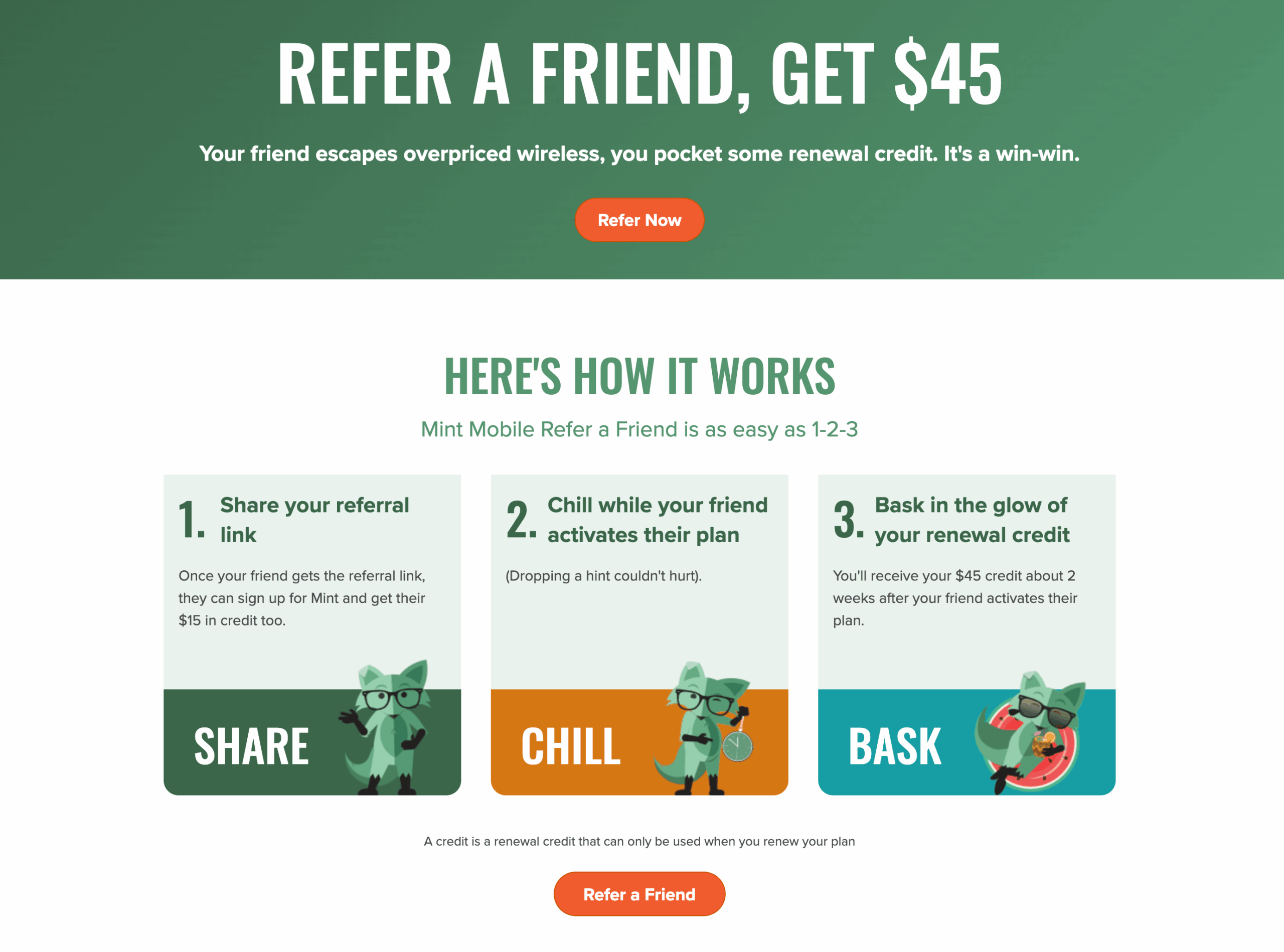
Telecom brands like Verizon, T-Mobile, Mint Mobile, and Cricket Wireless have all run sophisticated offer programs that demonstrate the power of this model done right. Mint Mobile’s program, for example, offers subscribers a $45 bill credit upfront per successful referral—a simple, compelling incentive paired with brand-aligned creative and messaging that captures customers’ attention.
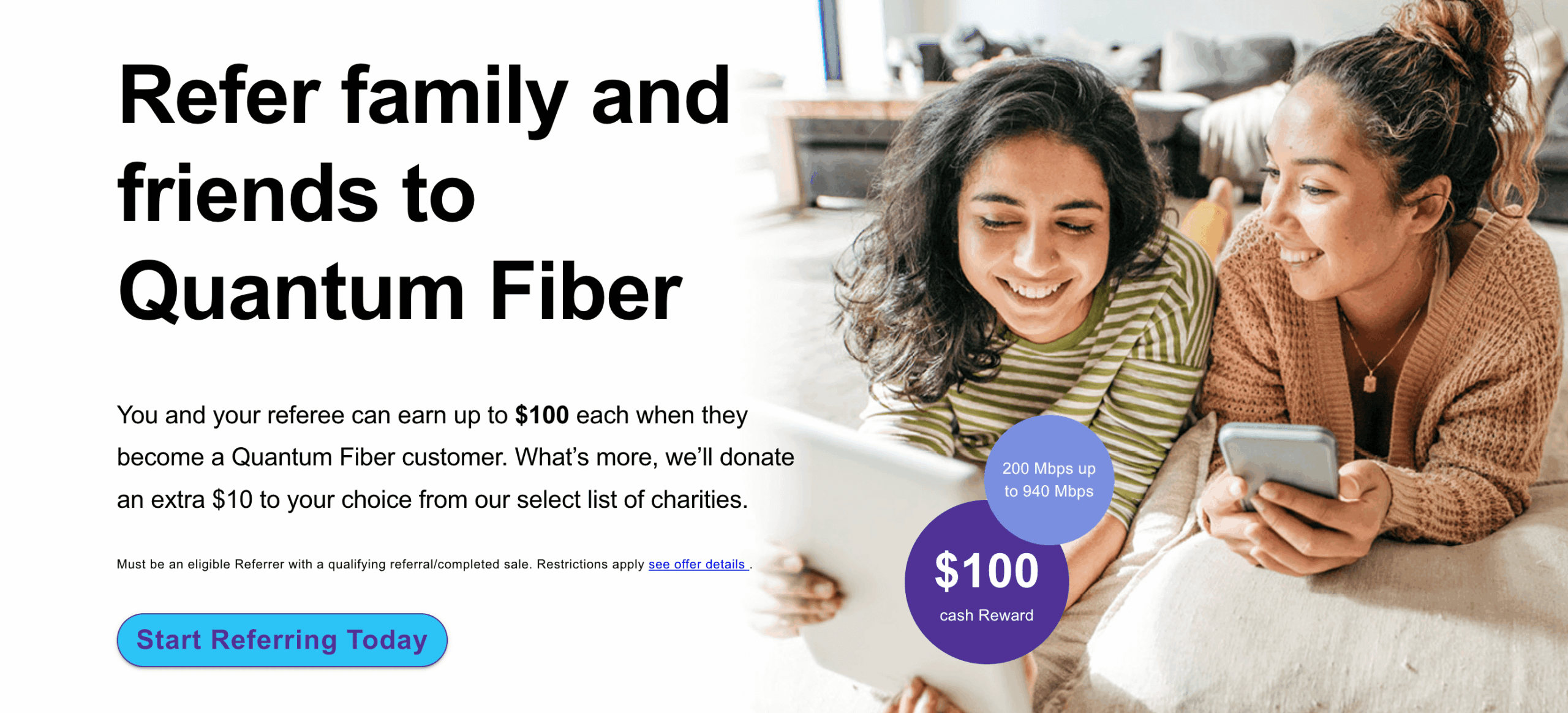
Quantum Fiber has structured its program to allow customers to earn a $100 credit for referrals, plus a bonus $10 charitable donation—combining a financial incentive with the opportunity to contribute to a good cause.
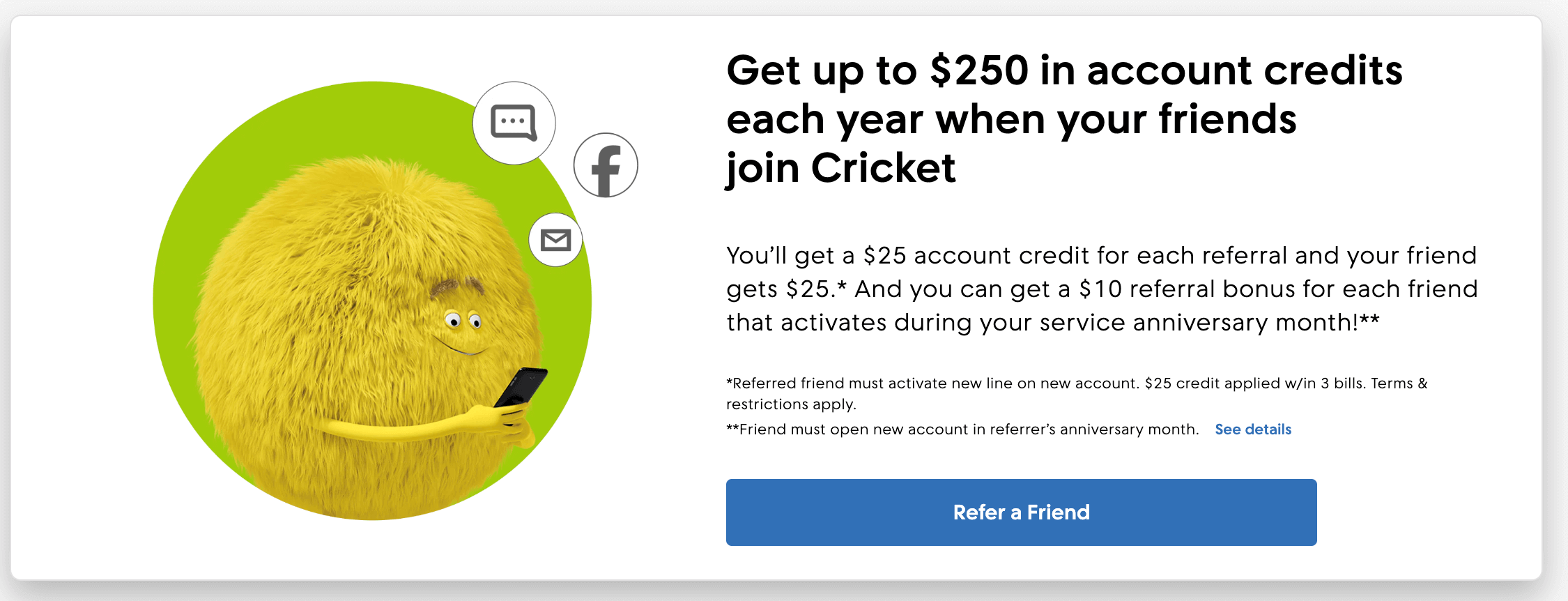
Cricket’s program ties a bonus referral reward to a customer’s service anniversary month, creating a sense of community and rewarding loyal subscribers.
The top telecoms and ISPs run offer programs curated for their unique subscriber community, driving acquisition and engagement through targeted offer programs. Following this model means finding the formula that resonates with your subscribers.
What Makes Telecom Offer Programs Uniquely Complex
Offer programs for consumer goods are relatively straightforward: Customers get rewards for making their first purchase, referring friends, or signing up for an email list. Telecom referral programs, on the other hand, require a level of sophistication that most referral platforms weren’t designed to handle. Here’s why:
Status-Based Reward Logic
Unlike a retail purchase that completes in minutes, a telecom subscriber journey can span weeks. A reward should fire only when a customer completes all qualifying actions: their service is activated, the first bill is paid, they’ve maintained their plan for 90 days, they’ve made X successful referrals, etc. This requires event-driven reward logic that ties into your billing and provisioning systems, not just your CRM.
Billing and Reward Integration
Bill credits are the most popular and effective reward in telecom referral programs—they’re instantly valuable, easy to understand, and reinforce the customer relationship. To apply bill credits automatically at scale, you need direct integration with your billing engine (Amdocs, Zuora, WHMCS, or a custom BSS/OSS stack). A platform that can only issue gift cards is not a fit for a serious telecom program.
Multi-Segment Program Architecture
A large carrier or ISP typically serves multiple audiences: residential consumers, small business customers, wholesale partners, and agents or dealers. Each segment has different motivations and will respond best to highly personalized offer programs. Residential customers respond to peer-to-peer programs. Agents and dealers need multi-tier commission logic. Business customers may require different incentive structures and approval workflows. Your referral platform needs to support all of these flows simultaneously without requiring separate tools or codebases.
Fraud Prevention at Scale
Telecom referral programs are high-value fraud targets. When a successful referral is worth $50 to $100 in credit, bad actors can exploit gaps in your program logic to earn rewards without completing qualifying actions. Your platform needs device fingerprinting, IP blacklisting, identity verification hooks, duplicate detection, and suspicious activity flagging to protect program integrity.
Field Sales and In-Person Engagement Opportunities
Telecom is not a purely digital industry: ISPs deploy field technicians to install equipment, carriers operate retail locations, and partner leasing agents pitch ISPs during apartment tours. These in-person moments are among the highest-quality customer engagement opportunities available—you need an on-the-go solution to capture them accurately and instantaneously.
Multi-Objective Program Design
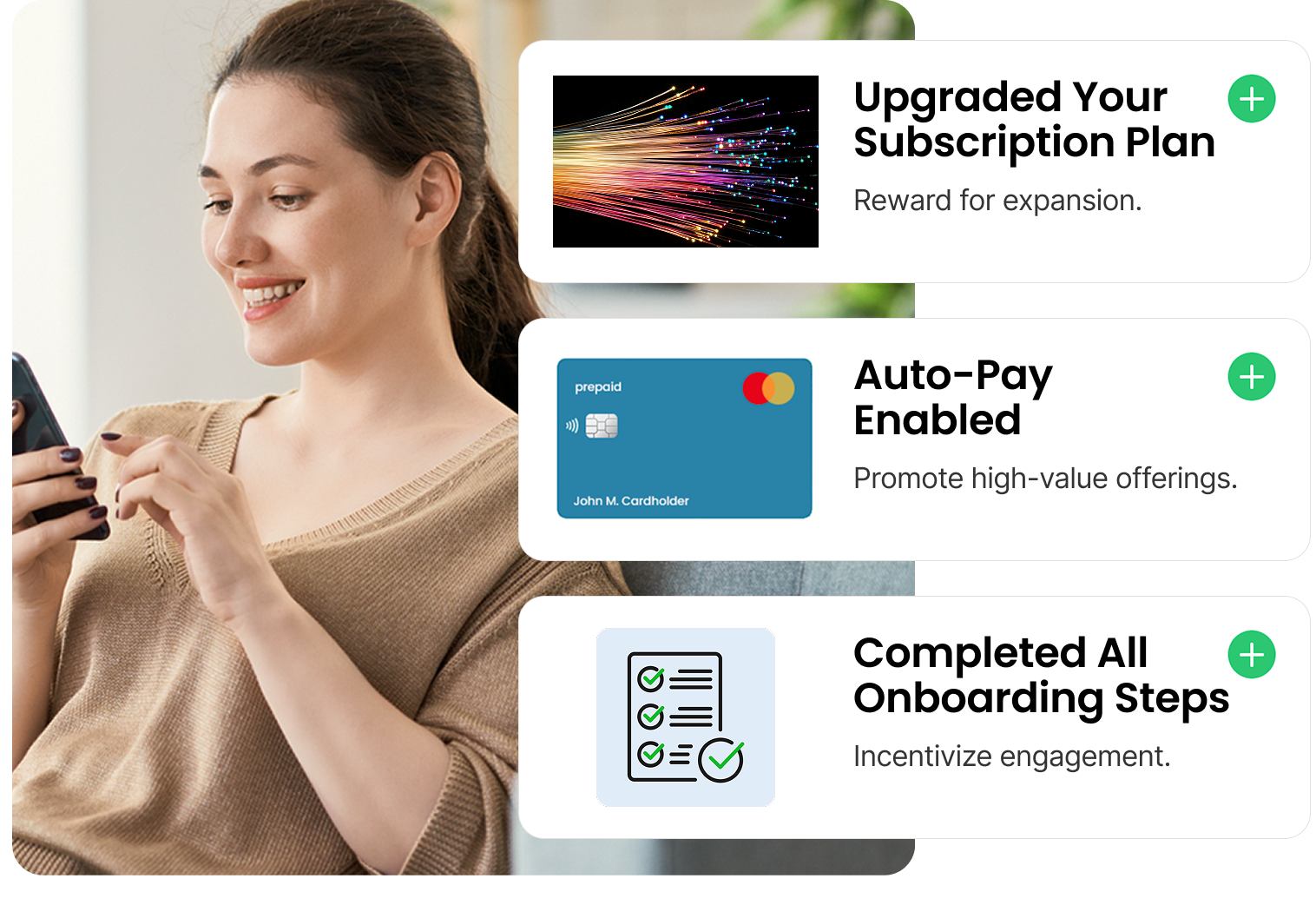
The most effective telecom programs reward more than just sign-ups. Plan upgrades, family plan additions, device activations, service renewals, and even community advocacy actions can all be tied to incentives. An offer management platform that only supports a single conversion event will never capture the full growth potential of your subscriber base.
Features of Top Offer Management Platforms
When evaluating offer management platforms for a telecom or ISP use case, these are the capabilities that separate enterprise-grade solutions from basic loyalty and refer-a-friend tools:
- Billing and CRM integrations (Salesforce, HubSpot, Amdocs, Zuora, BSS/OSS platforms)
- Event-driven and status-based reward triggers (reward on service activation, first bill paid, 90-day retention)
- Automatic bill credit application and recurring reward structures
- Double-sided incentives (reward both the referrer and the new subscriber)
- Multi-segment support (residential, business, partner/agent programs in one platform)
- Robust fraud prevention (device fingerprinting, IP blacklisting, identity verification)
- APIs and webhooks for tight integration with subscriber management and provisioning systems
- iOS and Android SDKs for in-app referral experiences
- Field employee mobile app for in-person referral capture
- A/B testing, advanced analytics, and real-time reporting tied to telecom KPIs
- Multi-objective program design (reward sign-ups, upgrades, renewals, family additions)
- Gamification and reward bank features to drive ongoing engagement
- User-friendly program builder with customizable templates
- Integration with marketing automation platforms such as email and SMS tools
How Extole Is Built for Telecom and ISP Referral Growth
Extole is among the best enterprise offer management platforms for major telecom brands, including Cox, Lumen, Xfinity, IQ Fiber, and Optimum. It’s designed from the ground up for complex, high-volume programs that operate across multiple subscriber segments, integrate deeply with billing and CRM systems, prevent fraud at scale, and reward a wide range of subscriber behaviors.
Enterprise-Grade Integration
Extole’s API-first architecture means it connects natively with the systems that matter most for telecom: Salesforce and HubSpot for CRM, billing platforms like Zuora and Amdocs via webhooks and file-based integrations, subscriber management systems, and your own BSS/OSS infrastructure.
Reward Bank and Status-Based Payouts
Extole’s Reward Bank is a powerful feature for telecom use cases. Rather than issuing a one-time gift card, it can stack rewards, such as $10 monthly bill credits, into a subscriber’s reward account and apply them automatically when specified milestones are met (service activation, first payment, 60-day retention). This makes the reward feel ongoing and sticky, which is exactly what reduces churn. You can also configure reward tiers based on the plan a new subscriber selects, such as rewarding more for a premium plan sign-up than a basic one.
Advanced Fraud Prevention
Extole’s built-in fraud prevention is designed for the high-stakes environment of telecom promotions. It combines device fingerprinting, IP blacklisting, duplicate detection, and suspicious activity monitoring to protect your program from abuse. Fraud controls are configurable, so you can calibrate sensitivity based on your program’s risk profile without blocking legitimate referrals.
Multi-Segment Program Architecture
Extole supports simultaneous programs across customer segments without requiring separate platforms. You can run a residential refer-a-friend program, a business customer advocacy program, and an agent referral program—each with distinct reward logic, messaging, and tracking—from a single platform. This matters enormously for carriers and ISPs whose customer base spans multiple commercial segments.
A/B Testing and Real-Time Analytics
Extole’s analytics suite ties referral program performance directly to business outcomes: new subscriber counts, churn rates, plan mix, and ARPU impact. A/B testing lets your team continuously optimize incentive amounts, messaging, email templates, and promotional placements to find the right formula for each audience segment.
Omnichannel Referral Experiences
Extole’s programs can be embedded anywhere your subscribers interact with you: your customer portal, your mobile app (iOS and Android SDKs), your website, post-activation emails, and in-store experiences. Your referral program will be highly visible to customers, woven into the existing subscriber experience via natural touchpoints.
Go Extole: The Mobile App Built for Telecom Field Teams
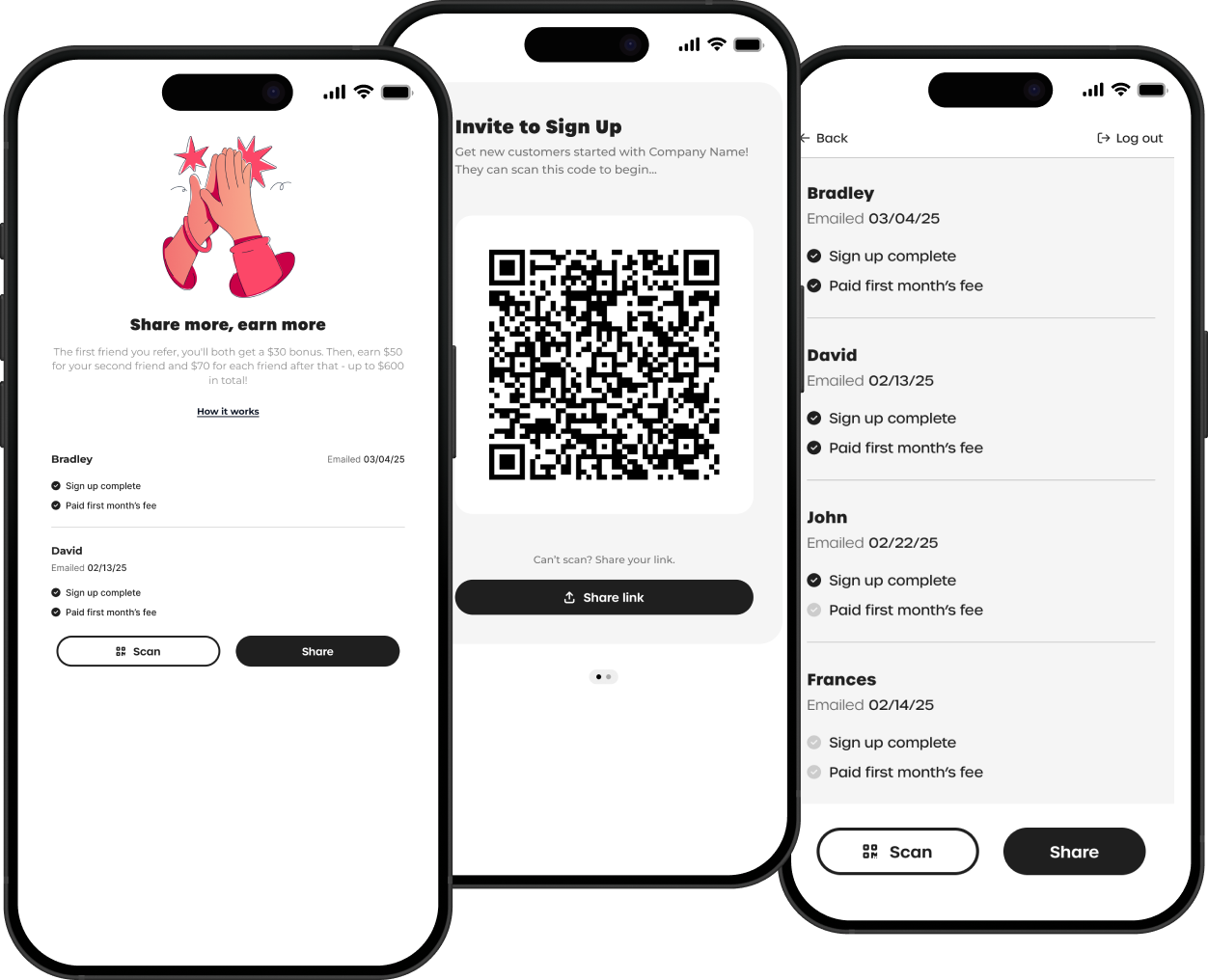
Go Extole is Extole’s mobile app for field teams and employee ambassadors, built to power customer engagement on-the-go. Available on iOS and Android, it puts your company’s referral program directly into the hands of every field employee, turning store associates, service technicians, door-to-door reps, and property managers into trusted referral touchpoints.
How It Works
- Download the Go Extole app onto mobile devices (phone or tablet) used by your field installers, technicians, or sales reps
- Each employee gets a personalized QR code and referral link to display on their device
- During a service call, a retail interaction, or a door-to-door conversation, the employee can share their QR code on the spot
- Prospective subscribers who scan are funneled into your referral flow with the employee’s attribution already attached
- Employees can track referral performance in real time through the app’s stats dashboard: who’s been referred, which steps have been completed, and whether a reward has been earned
Why This Matters for ISPs and Carriers
Consider the ISP technician who just finished installing a fiber connection in a customer’s home. The customer is delighted. The technician has 20 minutes left in the appointment. There are neighbors within a hundred yards. This is a referral moment that a web-only program simply cannot capture.
With Go Extole, that technician pulls out their phone, shows the customer a QR code, and the satisfied customer can immediately share the referral with their neighbor — or the technician can knock on the neighbor’s door with an offer already in hand. The conversion attribution is accurate, the reward is automated, and the company has just acquired a new subscriber at a fraction of the cost of a paid channel.
Go Extole is also valuable for:
- Retail store associates who interact with hundreds of walk-in customers weekly
- Door-to-door sales teams canvassing new developments or MDUs
- Property managers and leasing agents who can promote your service to new residents
- Customer service representatives who can share a referral link during support calls or chat sessions
No developer work is required to set up or modify employee ambassador programs in Go Extole. Your marketing team controls the offer, the messaging, and the reward logic, and program changes go live in the app immediately.

Telecom Offer Program Types You Can Run on Extole
Extole supports multiple referral program architectures that are directly applicable to the telecom and ISP business model:
Customer-to-Customer (Refer-a-Friend)
Your most satisfied subscribers refer their friends, family, and neighbors in exchange for bill credits, gift cards, or account upgrades. Double-sided incentives — where both the referrer and the new subscriber are rewarded — consistently outperform one-sided programs. Extole’s Reward Bank allows you to structure these as recurring monthly credits rather than one-time bonuses, keeping both parties engaged with the program over time.
Employee Ambassador Programs
Through Extole’s employee referral program, field employees earn rewards by referring new subscribers directly. They can also recruit existing customers as advocates, encouraging them to refer their own networks. This creates a two-layer referral effect from a single employee interaction.
Multi-Tier Agent and Dealer Programs
For ISPs and carriers with dealer networks, Extole supports multi-tier referral logic, allowing agents to refer other agents and earn commissions at each level. This is especially valuable for rapidly scaling fiber providers and MVNOs with distributed sales channels.
Upgrade and Expansion Programs
Referral isn’t only for new subscribers. Extole lets you reward existing subscribers for upgrading to a higher-tier plan, adding lines to a family plan, or activating new services. These ARPU-boosting programs are often overlooked but can deliver immediate revenue impact from your existing base.
Churn-Prevention and Re-Engagement Programs
Extole can trigger referral invitations and reward offers at key moments in the subscriber lifecycle: when a customer completes an installation, renews their contract, or hits a service anniversary. These touchpoints reinforce the relationship and naturally prompt advocacy.
Getting Started: Building Your Offer Program with Extole
The most successful telecom programs we see share a few characteristics: they have a compelling incentive (bill credits work best, along with tiered rewards), they trigger rewards based on meaningful milestones (not just clicks), they are embedded in the subscriber journey rather than existing as a separate landing page, and they extend to field teams with a mobile tool.
If you’re evaluating offer management platforms or thinking about upgrading your offer programs, here’s a practical starting framework:
- Audit your current offer programs: What reward are you offering? When does it trigger? Are you running double-sided incentives? Do you have field team participation?
- Map your integrations: What CRM, billing platform, and subscriber management system do you use? What events (activation, first bill, renewal) should trigger rewards?
- Define your segments: Residential, business, agent/dealer, employee. Each segment may warrant its own program logic.
- Design your incentive structure: Flat bill credit vs. tiered by plan. One-time vs. recurring monthly. Single-sided vs. double-sided.
- Plan for field activation: Do you have technicians, retail staff, or field sales? Go Extole can be live for them in days.
- Set your fraud parameters: Define your risk tolerance and configure fraud controls before launch.
- Promote your program: Map out where and how to promote your program across channels. Embed it in your subscriber portal, add a menu item to your homepage, and integrate it into existing email flows so subscribers are continuously reminded of opportunities to earn rewards
Extole’s team works directly with telecom clients to configure programs, integrate with your tech stack, and optimize over time. Industry-specific referral program templates also allow for faster launch timelines than starting from scratch.
The Bottom Line
Subscriber acquisition in telecom is expensive. Churn is persistent. And carrier promotions only go so far. The brands that are building durable growth — the ones compounding their subscriber base quarter over quarter — are the ones that have invested in turning their customers and their field teams into acquisition engines.
Telecom companies looking to prioritize customer engagement and growth should consider investing in an offer management platform with billing integration, fraud controls, field team tooling, multi-segment logic, and continuous optimization. Extole is built to run exactly that kind of program—and the Go Extole mobile app ensures that even your most in-person, offline growth moments are captured and attributed.
To talk to our team about how Extole powers referral growth for telecom companies and ISPs, please visit this page.
Telecom Offer Management Platforms: FAQs
Based on how telecom operators and ISPs are evaluating referral software today, here are answers to the questions that come up most:
Does Extole support bill credits as a reward type?
Yes. Bill credits are the most effective and popular reward in telecom, and Extole’s platform is built to support automatic credit application via billing system integration. You configure the trigger (service activation, billing milestone, retention period), and Extole handles the rest.
Can I reward different amounts based on the plan someone selects?
Yes. Extole’s reward logic is fully configurable. You can offer a higher referral reward for a premium plan sign-up than a basic plan, or tier rewards based on contract length, device activation, or any other subscriber attribute.
What happens if a referred subscriber’s service isn’t activated for several weeks?
Extole handles exactly this scenario. Reward triggers are event-based and status-driven, meaning the reward only fires when the CRM or billing system confirms the status change from “Order Placed” to “Service Active.” Pending referrals are tracked and rewarded automatically when the triggering event occurs.
We have ISP technicians and door-to-door sales reps. Can they participate in the referral program?
This is precisely what Go Extole was built for. Your field employees can run the referral program from their phone — sharing personalized QR codes and links on the spot, tracking their own referral activity, and earning rewards when their referrals convert. No hardware, no paper forms, no manual tracking.
We’re an MVNO/fiber provider scaling quickly. Is Extole right for our size?
Extole is designed for mid-to-large enterprise brands. It’s the right fit for telecoms and ISPs that are past the startup phase and need a platform that can handle high-volume programs, multiple segments, and deep integrations without breaking. If you’re a rapidly scaling fiber provider or MVNO with serious growth ambitions, Extole’s infrastructure and dedicated support model are built for that trajectory.
How does referral marketing help telecom companies reduce churn?
Referred subscribers churn at lower rates than customers acquired through paid channels — they came in through a trusted recommendation and tend to have stronger brand affinity from day one. Beyond that, well-designed referral programs create ongoing engagement touchpoints: reward reminders, re-share prompts, and anniversary incentives that keep existing subscribers active and invested in the program. Extole lets you trigger referral invitations at key lifecycle moments — post-installation, contract renewal, service anniversary — turning retention touchpoints into new acquisition opportunities at the same time.
What CRM and billing systems does Extole integrate with?
Extole integrates natively with Salesforce and HubSpot for CRM, and connects to billing platforms like Zuora and Amdocs via webhooks and file-based integrations. For ISPs running custom BSS/OSS infrastructure or platforms like WHMCS, Extole’s API-first architecture allows for flexible custom integrations. This means referral attribution, reward triggers, and subscriber status updates all flow automatically between systems — no manual reconciliation required.
What’s a double-sided referral incentive, and should we use one?
A double-sided incentive rewards both the existing subscriber who makes the referral and the new subscriber who signs up. For example: “$50 bill credit for you, $50 off your first month for your friend.” Double-sided programs consistently outperform one-sided programs because they give the referring subscriber a compelling reason to share and give the new subscriber a reason to act. For telecom, where switching costs feel high to consumers, a new subscriber discount can be the nudge that converts a curious prospect into a paying customer.
How do we prevent referral fraud in a high-volume telecom program?
Telecom referral programs are high-value fraud targets — when a successful referral is worth $50 to $100 in credit, bad actors will look for ways to exploit your program. Extole’s built-in fraud prevention combines device fingerprinting, IP blacklisting, duplicate identity detection, and suspicious activity monitoring to protect program integrity at scale. Fraud controls are fully configurable, so you can tune sensitivity to your program’s risk profile without blocking legitimate referrals. Status-based reward triggers (rewards that only fire after service activation and first payment) also act as a natural fraud deterrent.
Can Extole run referral programs for both residential and business customers simultaneously?
Yes. Extole supports simultaneous, independent programs across multiple subscriber segments — residential consumers, small business customers, wholesale partners, and agent or dealer networks — each with its own reward logic, messaging, eligibility rules, and tracking. This is a critical capability for carriers and ISPs whose customer base spans multiple commercial segments, and one that most lighter-weight referral tools simply can’t support.
How is a referral program different from a carrier promotion?
Carrier promotions — free phones, discounted plans, trade-in bonuses — are expensive to run, easy for competitors to match, and don’t build lasting loyalty. They attract deal-seekers who are just as likely to churn when the next promotion comes along. A referral program, by contrast, leverages your most satisfied existing subscribers to do the acquisition work for you. Referred customers cost less to acquire, churn at lower rates, and are more likely to become advocates themselves. Where promotions are a margin expense, a well-run referral program is a compounding growth asset.