Blog
Referral Marketing Concepts
Why Referral Marketing Works: 8 Benefits for Business Growth
Paul Davidson


Products
Enterprise platform
Platform features
Acquisition programs
Retention programs
Learn
Resources
Developers
Documentation
SDKs & GitHub
Blog
Paul Davidson
Businesses today are still looking for the most effective marketing strategy that yields solid, consistent results—and the evidence points in one direction: referral marketing. And it's not just customer acquisition; referral marketing benefits span every facet of business growth, from awareness to acquisition to retention and lifetime value.
According to McKinsey's State of the Consumer 2025, family and friends influence buying decisions in Europe and the United States more than any other source. Social media influences them the least. That pattern shows up across referral marketing statistics: people trust recommendations from the people they know. The 2025 Edelman Trust Barometer reports that trust is now as much a purchase consideration as quality and price. Meanwhile, customer acquisition costs have risen significantly across industries over the past several years, making expensive paid channels harder to justify. Referral marketing addresses both problems at once: it generates high-quality customers at a lower cost by activating the trust your existing customers already have. Referral marketing is a growth strategy that motivates existing customers to recommend your products to people they know. When a referral converts, both the advocate and the referred friend typically earn a reward. This mechanism drives ongoing referral participation and compounds over time. [caption id="attachment_23456" align="alignright" width="423"]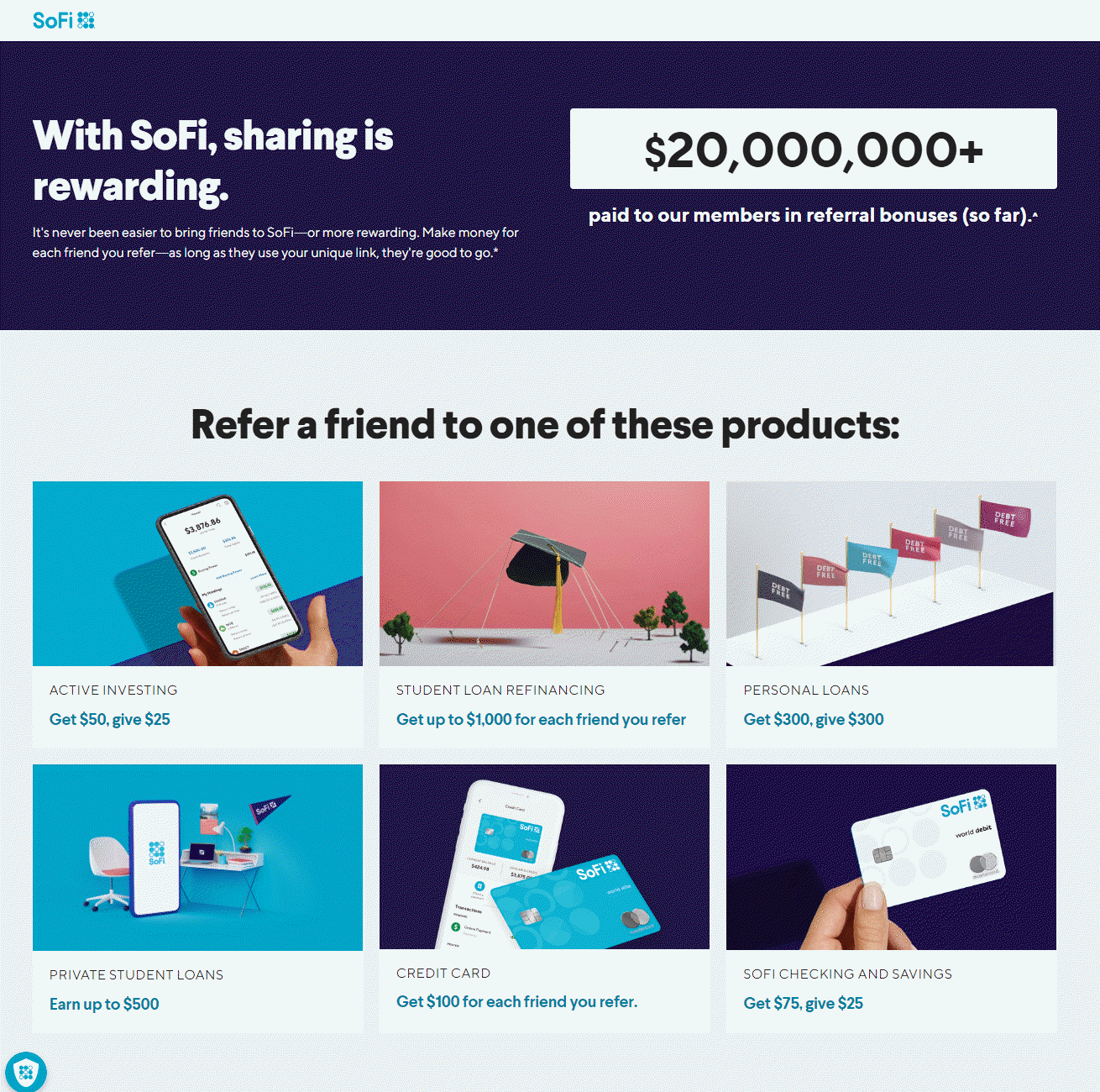 SoFi's multi-product referral program is an example of how brands can use referrals to drive cross-selling and deepen engagement.[/caption] As a staple of consumer marketing, referral programs are used by companies across retail, financial services, telecom, and many other industries. Brands rely on them to reduce acquisition costs, increase customer lifetime value, and drive sustainable growth built on customer trust. In this article, we'll cover eight key referral marketing benefits. We'll also explain what makes it one of the most effective growth levers for enterprise brands.
A referral program creates a structured, repeatable loop in four steps:
What makes referral marketing different from traditional advertising is the source of the recommendation. When a friend tells you to try a product, you arrive with pre-established trust and a higher likelihood of converting. That's why referred customers typically convert at a significantly higher rate than customers acquired through paid channels. Well-designed referral programs from brands like Dropbox, Uber, and PayPal have become some of the most cited examples of efficient, scalable customer growth. Modern referral programs go well beyond a simple link. With the right platform, brands can personalize rewards by segment, run A/B tests on incentive offers, and detect and reward super advocates. They can also prevent fraud and connect referral data to their broader marketing and analytics stack. That turns word-of-mouth from an unpredictable channel into a measurable, scalable growth engine.
These eight referral marketing benefits compound across acquisition, retention, and advocacy:
One of the clearest referral marketing benefits is improving customer lifetime value (LTV). This metric measures the amount of money a customer has or is expected to spend with your business. Referral programs tend to attract highly valuable customers—loyal customers who spend more. A Forrester Total Economic Impact study of four Extole customers found 298% ROI or more and $19.1M in incremental revenue over three years. In Extole's own program data, one clothing retailer saw referred customers' first purchase reach almost twice that of non-referred customers. A furniture retailer found advocates and referral recipients made up a substantial share of repeat purchasers. There are a couple of reasons for this behavior. Referred customers come with a level of built-in trust, so they are likely to spend more than someone encountering your brand for the first time. In addition, these customers are a great fit for your product because they were referred by someone who knows their needs well.
Acquiring customers at all costs eats into your profits and leads to a poor LTV:CAC ratio. Referrals help lower CAC by reducing your reliance on more expensive acquisition channels such as pay-per-click or print advertising. Referral marketing is also more cost-effective because consumers trust their friends and family for product recommendations, so they're more likely to convert. When you combine this with a great reward, you can acquire more customers at a significantly lower cost than most paid alternatives. Rewards are tied to completed conversions rather than impressions or clicks. For example, mattress retailer Lull saw a strong conversion rate with its referral marketing program, which rewarded advocates with an Amazon gift card. That result landed well above typical benchmarks for paid acquisition channels.
When brand advocates receive a reward for referring a friend, it strengthens the emotional connection to your brand. The advocate feels valued, and the positive experience reduces the likelihood they'll switch to a competitor. A Journal of Marketing study by Schmitt, Skiera, and Van den Bulte (2011) tracked roughly 10,000 customers of a German bank. The study found that referred customers have a higher retention rate that persists over time. Research in the Journal of Marketing Research (Gershon and Jiang, 2024), summarized in Harvard Business Review, finds that referred customers refer 30–57% more new customers. That creates a compounding loyalty effect that grows the longer your program runs. Referral marketing pays forward: the customers you acquire through referrals are more likely to become your next generation of advocates. In addition, referral rewards encourage repeat purchases. For example, a free shipping offer or a discount increases the chances that the advocate stays loyal for their next purchase and beyond. With Extole's offer management platform, you can detect super advocates in your referral program and reward them with special offers to show your appreciation.
With referral tracking, your marketing team can glean a wealth of customer insights powered by first-party data—data collected directly from your audience. The data allows you to answer questions such as:
And much more. These answers enable you to enrich and optimize your marketing strategy to get even better results. In addition, referral tracking helps you measure the ROI of the entire program, tying your efforts to tangible business results.
Over time, referral marketing builds brand advocacy by encouraging customers to talk about and recommend your products. Brand advocates are crucial for every business because they won't keep their support private—they'll also publicly endorse your brand on social media, review sites, and other platforms, drawing in new customers via authentic recommendation. In Extole's experience, about 20% of advocates drive roughly 80% of referrals. Identifying and rewarding your top advocates compounds those results over time. Grow your pool of brand advocates by personalizing referral rewards. Instead of taking a one-size-fits-all approach, segment your audience by age, interests, or other attributes and offer incentives that speak to their needs.
An important benefit of referral marketing is that it improves engagement by encouraging customers to become active brand advocates. With a referral program, customers interact with your brand more often, not just when they want to make a purchase. As they refer more of their friends and family, your brand comes up in conversations more often. That creates a sense of community around a shared interest. For example, Bestseller, a global apparel retailer, implemented a referral program to acquire new customers and re-engage existing ones. The impact on engagement was significant, resulting in dramatically more advocate sharing and stronger program participation than the brand had seen through traditional digital marketing.
Customer-led marketing uses your existing customer base to advertise your products instead of relying almost exclusively on expensive digital ads. A referral marketing program is essential for this type of marketing since it allows customers to grow your business by inviting their friends. And because there is a reward involved, they are motivated to keep sharing their referral invites. This marketing strategy is part of customer-led growth. Extole CEO Matt Roche defines it as turning existing customers into the primary channel for improving awareness, acquisition, and activation. Customer-led growth also prioritizes customer feedback when developing new products, optimizing existing ones, and improving the overall customer experience. In Extole's experience, customer-led growth can be among the least expensive acquisition methods. That advantage grows as media costs rise and data deprecation spreads through privacy laws and ad-blocking software.
Personalization leads to repeat purchases and more loyalty. With the right referral marketing software, you can segment your audiences and tailor your communication based on their level of engagement, interests, or other attributes. Using Extole's platform, for example, you can group customers based on how much revenue their referrals generated for your business. Then, you can tailor your communications to each segment. You might recognize Super Advocates with a special email highlighting their status, or nudge disengaged advocates to start referring again.
The referral marketing benefits above range from higher LTV to stronger engagement. But how do you build this customer acquisition engine so it runs efficiently and sparks advocate sharing? In Extole's latest referral marketing playbook, we've compiled ten high-impact referral plays to help you unlock real referral growth.
The main referral marketing benefits compound over time. Referral marketing lowers customer acquisition costs, increases customer lifetime value, and builds a self-reinforcing loop of brand advocacy. Programs also generate first-party behavioral data that teams can use to optimize rewards and campaign performance.
A referral program runs on a simple loop. An advocate shares a unique referral link or code with someone in their network. When the friend converts, both the advocate and the friend earn a reward, and the new customer can start the loop again.
Referral marketing works because people trust recommendations from friends and family far more than advertising. Referred customers arrive with pre-established trust, convert at higher rates, and are more likely to become advocates themselves. That trust-based dynamic separates referral marketing from channels where you start from zero with every new prospect.
Yes. Referred customers have meaningfully higher retention rates than customers acquired through other channels. Referral rewards also reinforce advocates' emotional connection to the brand, and identifying super advocates lets you deepen those relationships with personalized offers.
Referral marketing is one of the most effective customer acquisition channels available. Referred customers convert at significantly higher rates than customers from paid channels, because they arrive with peer-validated trust. Since rewards are tied to completed conversions rather than clicks, acquisition economics improve as paid media costs rise.
Refer-a-friend marketing is highly effective because consumers trust friends and family for product recommendations. Referred customers are consistently more valuable than non-referred ones in average order value, retention, and likelihood of referring others. For example, mattress retailer Lull saw a strong conversion rate through its Extole-powered referral program.
Referral marketing motivates customers to recommend a brand's products to people they know. In return, they earn rewards such as points, discounts, or special offers. The broader purpose is to turn customer satisfaction into a scalable, measurable acquisition and retention channel.
Loyalty programs reward customers for repeat purchases and ongoing engagement with your brand. Referral programs reward existing customers for bringing in new customers through word-of-mouth. Many brands run both together so that acquisition and retention reinforce each other.

Customer lifetime value (LTV) is the measure of how much money a customer has or will spend with your business.

Take a closer look at how to design referral emails that get readers to click and take action.

Some of it is due to rising paid media costs. But it’s also the nature of doing business. You need more resources to reach more customers – including those unaware they even…