


How to Build a Native App Referral Program That Converts
Your customers are already engaging with your brand across multiple channels, from online to in-app to SMS and email—the question is whether you’re actually leveraging every touchpoint as the growth opportunity it is. When you promote referral rewards at every possible touchpoint, you maximize the places where customers can easily share your brand with friends. This article covers one of the most important growth channels for brands with a strong mobile presence: A native app referral program.
A native app referral program meets customers where they already are—their phones—and delivers a frictionless embedded sharing, tracking, and reward experience that makes advocates and referred users more likely to convert. This guide covers the core components, reward design strategies, implementation steps, and measurement frameworks that separate high-performing programs from ones that sit unused in a settings menu.
What Is a Native App Referral Program
A native app referral program is a structured system built directly into a mobile application that incentivizes existing users to recommend the app to friends and family. Unlike web-based referral programs that rely on browser cookies and landing pages, native programs use mobile-specific technology—deep links, unique referral codes, and native share sheets—to track when someone downloads the app because of a recommendation and automatically reward both the person who shared and the person who joined.

The “native” distinction matters here. Mobile users expect experiences that feel seamless, not ones that bounce them between browsers, app stores, and back again. A native referral program lives inside the app itself, using device capabilities like one-tap sharing to SMS, social media, or WhatsApp, QR codes for in-person moments, and push notifications to keep advocates engaged.
- Native integration: Referral flows embedded in the app UI rather than external web pages
- Mobile-first sharing: Direct access to contacts, messaging apps, and social platforms
- Attribution through installs: Deep links that preserve referral context even when users go through the app store
Why Mobile Apps Benefit From Referral Programs
Referral programs solve a persistent problem in mobile growth: acquisition costs keep climbing. Referred customers cost significantly less to acquire than users from paid advertising, and they tend to stay active longer. When a friend recommends an app, that recommendation carries a level of trust that paid ads simply can’t replicate.
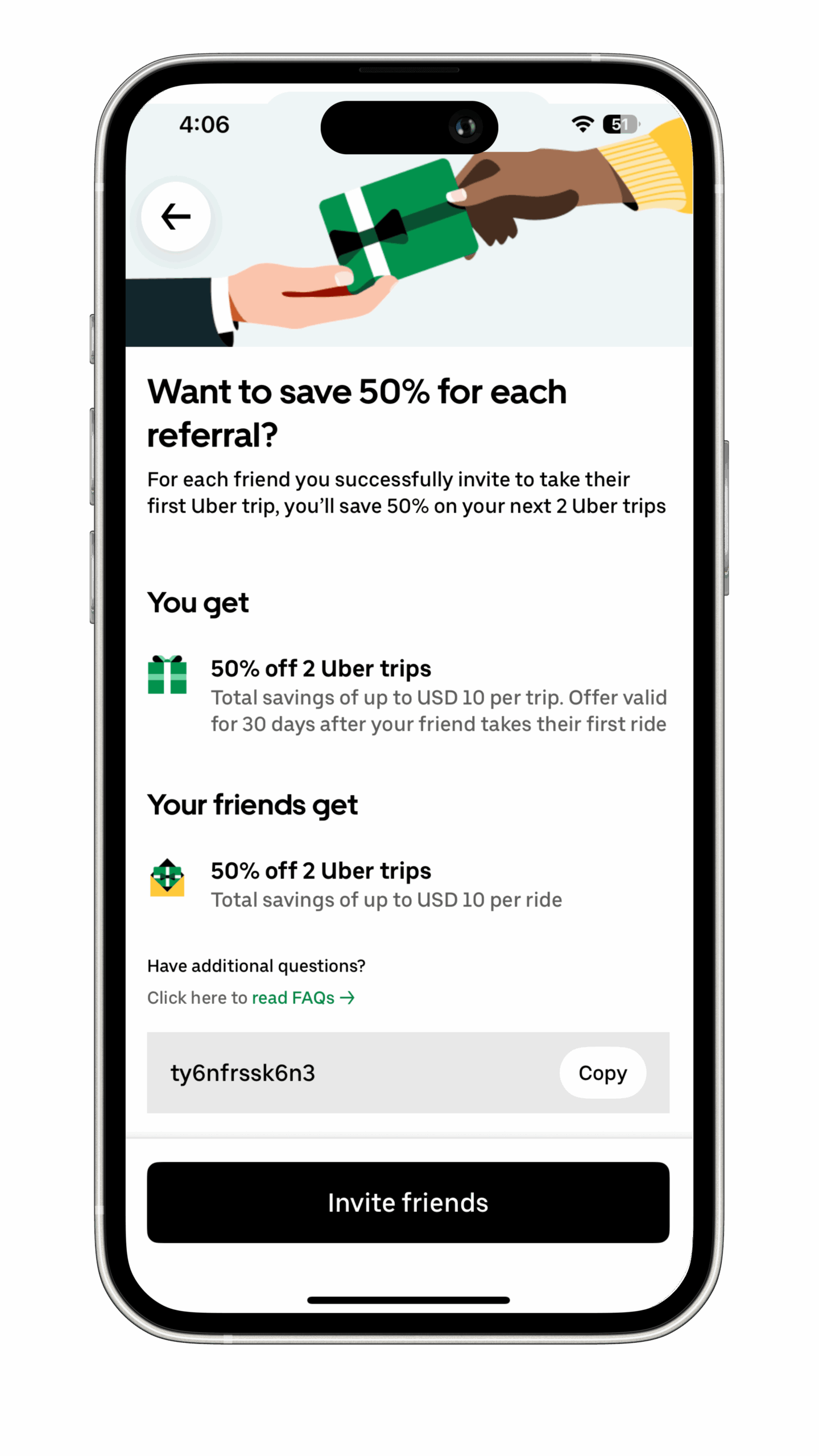
There’s also a compounding effect at play. Each new user who joins through a referral becomes a potential advocate, which creates a flywheel: more users lead to more referrals, which lead to more users. Brands like Dropbox and Uber built referral into their growth strategies early for exactly this reason.
- Lower acquisition costs: Referred users typically cost a fraction of paid channel acquisitions
- Stronger retention: Users who arrive through personal recommendations have 16% higher lifetime value
- Built-in credibility: Word-of-mouth drives 20–50% of purchasing decisions, outweighing paid advertising
- Network effects: Your customer base becomes a distribution channel
Core Components of a Native App Referral Program
Before launching a referral program, it helps to understand the building blocks that make mobile referrals work. Each component plays a specific role in tracking, rewarding, and protecting the program.
Unique Referral Links and Codes
Every advocate receives a personalized link or code that ties new users back to them. Some programs use memorable codes like SARAH25, while others generate unique URLs that handle attribution automatically. Either way, the identifier is what makes accurate tracking possible when someone shares via text, email, or social media.
Deep Linking and Mobile Attribution
Deep linking is the technology that routes users directly into your app, even when they don’t have it installed yet. Here’s the challenge: when someone clicks a referral link, gets redirected to the app store, installs the app, and opens it for the first time, the referral context can easily get lost. Deep links preserve that context through the entire journey, so the right advocate gets credit.
Double-Sided Incentives
The most effective programs reward both sides of the referral. The advocate receives something for sharing, and the new user receives something for joining. This two-sided structure creates motivation at both ends—advocates feel good about giving friends a benefit, and friends have a concrete reason to act on the recommendation.
In-App Sharing Mechanics
How easy is it to actually share? One-tap access to SMS, WhatsApp, or social platforms removes friction. Pre-populated messages save users from writing their own pitch. QR codes enable in-person sharing at coffee shops or events. The easier the share experience, the more people follow through.

Reward Fulfillment Engine
Rewards get issued automatically when qualifying events occur. This requires rules-based logic that determines eligibility, triggers fulfillment, and handles edge cases like duplicate referrals or returns. Enterprise platforms like Extole provide this infrastructure out of the box through open APIs and mobile SDKs.
Fraud Prevention Controls
Mobile referral programs can attract abuse—fake accounts, device farms, self-referrals. Effective programs run fraud detection in real time without blocking legitimate users. Device fingerprinting, velocity limits, and event verification work together to protect program integrity.
Real-Time Event Tracking
Tracking referral events as they happen—shares, clicks, installs, conversions—powers both analytics and reward triggers. Without real-time visibility, teams can’t see what’s working, and users may experience delays in receiving rewards.
How to Design Rewards That Drive Conversions
Reward design is often where programs succeed or fall short. The right incentive structure aligns what users value with what the business can sustain.
Advocate Rewards
Advocates respond to rewards that reflect what they actually value in the app. Account credits work well for transactional apps. Free subscription time appeals to users of premium services. Cash or gift cards make sense for high-value conversions where the economics support larger payouts.
Referred Friend Rewards
New users also benefit from an incentive to complete signup or take their first action. Discounts, free trials, or bonus credits lower the barrier to trying something new. The friend reward often determines whether a referral converts or stalls at the download stage.
Tiered and Milestone Rewards
Some programs offer escalating rewards based on the number of successful referrals. A user who refers three friends might unlock a bonus, creating ongoing motivation for power advocates to keep sharing.
| Reward Type | Best For | Example |
|---|---|---|
| Account credit | Subscription and fintech apps | $10 credit per referral |
| Free subscription time | Streaming and SaaS apps | 1 free month for each referral |
| Exclusive features | Freemium apps | Unlock premium features |
| Cash or gift cards | High-value conversions | $25 payout after friend’s first purchase |
How to Build a Referral Program for Your Mobile App
Here’s the practical path from concept to launch. Each step builds on the previous one, so the sequence matters.
Step 1. Define Goals and Success Metrics
Start by clarifying what success looks like. Are you optimizing for new user acquisition, revenue growth, or engagement? The answer shapes everything from reward structure to measurement. Identify the KPIs you’ll track—conversion rate, cost per acquisition, viral coefficient—before building anything.
Step 2. Choose the Referral Trigger Event
The trigger event is the action the referred user completes for rewards to be issued. This might be account creation, first purchase, or subscription start. Choose an event that balances ease of completion with genuine value to the business.

Step 3. Design the Reward Structure
Decide on reward type, value, and whether it’s one-sided or double-sided. Align rewards with what motivates your users and what makes sense for unit economics. Personalized incentive programs that adapt to user segments often outperform one-size-fits-all approaches.
Step 4. Integrate the Mobile SDK and APIs
Technical integration embeds referral functionality into the app. Enterprise platforms provide SDKs for iOS and Android along with APIs for custom implementations. This is where engineering connects the referral infrastructure to user flows and backend systems.
Step 5. Build the In-App Referral Experience
Design where referrals live in the app, how users access their link, and how sharing works. The experience works best when it feels native rather than bolted on. Consider placement in navigation, post-purchase flows, or achievement moments where users are most engaged.
Step 6. Launch, Test, and Optimize
Soft-launch to a subset of users first. Monitor performance, gather feedback, and iterate before full deployment. A/B test different reward amounts, messaging, and placement to find what drives the highest conversion. Optimization is ongoing, not a one-time effort.
How to Prevent Fraud in Mobile App Referral Programs
Fraud vectors in mobile referral programs include fake accounts, device farms, self-referrals, and referral code abuse. Multiple layers of defense work together to protect program economics.
- Device fingerprinting: Detects multiple accounts originating from the same device
- Velocity limits: Caps the number of referrals from a single user within a time period
- Event verification: Confirms that qualifying actions actually occurred before issuing rewards
- Manual review triggers: Flags suspicious patterns for human review
Enterprise referral platforms handle fraud prevention as part of core infrastructure. Building these controls from scratch requires significant engineering investment and ongoing maintenance.
How to Measure a Native App Referral Program
Measurement tells you whether your native app referral program is working and where to optimize. A few metrics provide the clearest signal.
Referral Conversion Rate
This is the percentage of referred users who complete the trigger event. It measures how effective the referral funnel is at turning clicks into conversions. Low conversion rates often point to friction in the signup flow or misaligned incentives.
Viral Coefficient
The viral coefficient (or K-factor) represents the average number of new users each existing user brings in. A K-factor above 1 means viral growth—each user generates more than one additional user. Even a K-factor of 0.5 meaningfully reduces overall acquisition costs.
Cost per Acquired Customer
Calculate this by dividing total reward costs by the number of conversions. Compare it to paid acquisition costs to understand the relative efficiency of the referral channel.
Lifetime Value of Referred Users
Compare the LTV of referred users to users from other channels. Research consistently shows that referred users have higher retention and spend more over time.
Best Practices for Mobile App Referral Programs
A few strategies help maximize program performance once you’ve launched.
Embed Referrals Into the Product Experience
Referrals perform better when they’re visible at natural moments in the user journey—post-purchase, after a milestone, or on the home screen. Burying them in a settings menu means most users will never find them.
Trigger Prompts at High-Intent Moments
Ask for referrals when users are most engaged. Right after a positive experience, achievement, or successful transaction is when users are most likely to share.
Personalize Offers With Audience Segmentation
Use segmentation to tailor referral offers based on user behavior, loyalty tier, or lifetime value. Power users may respond to different incentives than new users.
Make Sharing a Single Tap
Reduce friction by pre-populating share messages and enabling one-tap sharing to SMS, WhatsApp, social platforms, or via QR code. Every additional step in the share flow reduces completion rates.
Run Continuous A/B Tests
Test different reward amounts, reward types, and referral copy to find what drives the highest conversion. Small improvements compound over time across large user bases.
Build vs. Buy Your Native App Referral Infrastructure
Teams often debate whether to build referral infrastructure in-house or use a platform.
- Building in-house: Offers full control but requires engineering time for event tracking, reward logic, fraud prevention, fulfillment, and reporting
- Using a platform: Provides pre-built infrastructure—SDKs, APIs, reward engines, fraud controls, and analytics—so teams can launch faster and focus on customer experience
Enterprise platforms like Extole give developers the building blocks to create custom programs without rebuilding the underlying infrastructure. For teams weighing build vs. buy, the question often comes down to whether referral infrastructure is a core competency worth investing in—or whether engineering time is better spent elsewhere.
Ready to see what’s possible? Book a demo to explore how Extole helps enterprise brands build native app referral programs that convert.
Frequently Asked Questions About Native App Referral Programs
How does a native app referral program differ from a web referral program?
A native app referral program is embedded directly in the mobile app experience, using device-specific features like deep links, push notifications, and native share sheets. Web referral programs operate through browser-based flows and rely on cookies for tracking, which creates challenges when users move between devices or clear browser data.
How long does it take to launch a referral program for a mobile app?
Timeline depends on complexity and whether you build in-house or use a platform. Enterprise referral platforms with mobile SDKs can reduce launch time from months to weeks compared to custom development.
What is a mobile referral SDK and do I need one?
A mobile referral SDK is a pre-built code library that handles referral tracking, attribution, and sharing within your app. Using one accelerates implementation and ensures accurate attribution across app installs—particularly important given the complexity of tracking users through app store redirects.
How does mobile referral attribution work after iOS privacy changes?
Post-ATT, mobile attribution relies more heavily on probabilistic matching, SKAdNetwork, and first-party data like unique referral codes rather than device-level identifiers. Referral programs that use unique codes and deep links are less affected by privacy changes than programs that depended on device tracking.
Can I run a single referral program across both web and native app experiences?
Yes, enterprise referral platforms support omnichannel programs where users can share and redeem referrals across web and mobile with unified tracking and reward management.