


Referral marketing is one of the highest-ROI acquisition channels for e-commerce brands, and Shopify retailers are especially well-positioned to take advantage of it. Your customer base is already buying from you online, already sharing products with friends, and already operating in the same digital channels where referral programs perform best. The question is whether your Shopify storefront has all the functionality needed to track and optimize e-commerce referrals.
This guide is written specifically for Shopify Plus and enterprise retailers evaluating referral software. It covers what a well-designed Shopify referral program looks like, what to look for when choosing a referral platform, how Extole’s Shopify integration works, and the program design decisions that separate high-performing e-commerce referral programs from average ones.
In This Article
-
-
- Why Referral Marketing Works for Shopify Brands
- What Makes a Shopify Referral Program “Enterprise-Grade”
- How Extole’s Shopify Integration Works
- Choosing the Right Referral Platform for Your Shopify Store
- Program Design: What High-Performing Shopify Referral Programs Have in Common
- Shopify’s Built-In Tools That Drive e-Commerce Referrals
- Getting Started: What to Expect from an Extole Integration on Shopify
- Conclusion: Next Steps for Shopify Retailers
- FAQ
-
Why Referral Marketing Works for Shopify Brands
Word-of-mouth is already driving a significant portion of your revenue, but most brands aren’t measuring or rewarding it. A referral program formalizes that activity, automates the tracking, and turns your most loyal customers into a consistent acquisition channel.
The economics are compelling:
- According to Nielsen research, 92% of people trust recommendations from friends and family more than any other form of advertising
- 58% of consumers say that a loyalty or rewards program makes them more likely to buy from a retailer
- Referred customers make 27% more purchases than non-referred customers and spend 28% more
- Referred customers have a 16% higher LTV and an 18% lower churn rate than non-referred customers over a multi-year horizon.
- Referral marketing generates viral growth: Referred consumers generate 30-57% more referrals than non-referred consumers
For Shopify brands specifically, the referral opportunity is amplified by a few factors unique to e-commerce:
- Your customers are already sharing. Every time someone receives a package they love or discovers a product that solves a problem, there’s a natural impulse to tell someone about it. A referral program gives that impulse structure and reward.
- The purchase funnel is short. A referred friend can click a link and complete a purchase in the same session, which means referral programs in e-commerce often have faster time-to-conversion and easier attribution than in other industries.
- Email and SMS channels are already working for you. Referral programs plug directly into channels you’re already using, like Braze and Attentive, giving you a new promotion vehicle for your existing audience.
- Post-purchase moments are underutilized. The order confirmation page and post-purchase email are among the highest-engagement touchpoints in e-commerce, and most brands use them only to upsell or confirm logistics. A well-placed post-purchase offer reaches customers while their satisfaction is highest.
What Makes a Shopify Referral Program “Enterprise-Grade”
There’s a significant difference between lightweight Shopify app store tools designed for fast setup and enterprise referral platforms built for brands running complex, high-volume programs across multiple channels.
Here’s what separates enterprise-grade referral software from basic referral apps:
Native Shopify Integration with Automated Discount Code Generation
The most friction-prone part of any e-commerce referral program is reward delivery. Rewards for advocates and referred friends need to be generated, tracked, and delivered automatically, without manual work from your team.
Enterprise referral platforms integrate directly with Shopify to automate discount code generation. When a qualifying referral is completed, a unique discount code is created in Shopify and delivered to the advocate automatically. This eliminates manual reward fulfillment, removes the risk of duplicate codes, and keeps your reward ledger clean.
For Shopify Plus brands, this integration can be extended to support more complex scenarios: SKU-specific incentives (a reward only applies to a certain product category), tiered rewards (the incentive increases after a certain number of referrals), or points-based engagement and loyalty programs.
Braze and Email/SMS Integration
The brands that get the most out of referral are the ones that promote it through every channel: Email, SMS, in-app, and online.
Extole integrates natively with Braze, allowing you to embed referral CTAs directly into your email flows. Post-purchase flows, win-back campaigns, loyalty anniversary emails, and VIP segments are all natural places to surface a referral offer. You can pass referral data back into Braze to create segments based on referral behavior — for example, identifying your top advocates and treating them differently in your retention marketing.
The same logic applies to SMS through Attentive and other platforms: referral CTAs and referral tracking updates can be shared via text to engage customers who prefer this channel.
Omnichannel Attribution
Enterprise retailers are everywhere: they have a website, a mobile app, potentially physical retail locations, and a mix of email, SMS, and social. Your referral program needs to track across all of them.
If a customer shares a referral link via text message and their friend first browses on mobile but completes the purchase on desktop two days later, the advocate should still get credit. Extole’s attribution engine bridges those gaps, stitching together cross-device and cross-channel journeys so that referrals don’t fall through the cracks.
For Shopify brands with physical retail or in-store components, Extole also supports QR code-based referral capture and in-person referral flows so in-store referrals can be tracked and rewarded the same way digital referrals are.
A/B Testing and Optimization Infrastructure
Aggressive testing and optimizing creates high-performing referral and rewards programs. Enterprise referral platforms give you the infrastructure to run structured A/B tests that compare different reward values, reward types (cash vs. store credit vs. gift card), messaging, creative assets, and placement, so you can continuously improve program performance using valuable data.
Lightweight referral apps typically offer limited or no formal A/B testing capability. If you can’t test, you can’t optimize.
Advanced Fraud Prevention
At volume, referral fraud is a real problem. Self-referrals, duplicate accounts, and link farming can inflate program costs without generating customers. Enterprise referral platforms use device fingerprinting, IP-based anomaly detection, and configurable quality rules to catch fraudulent activity before rewards are issued, protecting your program budget and ensuring that rewards go to real advocates.
Read more on referral fraud here.
How Extole’s Shopify Integration Works
The Extole app lets you manage referral program CTAs from your Shopify dashboard, as shown in this mockup.
Extole supports both Shopify Plus and Shopify Hydrogen, giving enterprise retailers a path, whether they’re running a traditional Shopify storefront or a headless build. Both integrations start in the same place: the Extole app on the Shopify App Store.
Getting Started: Prerequisites
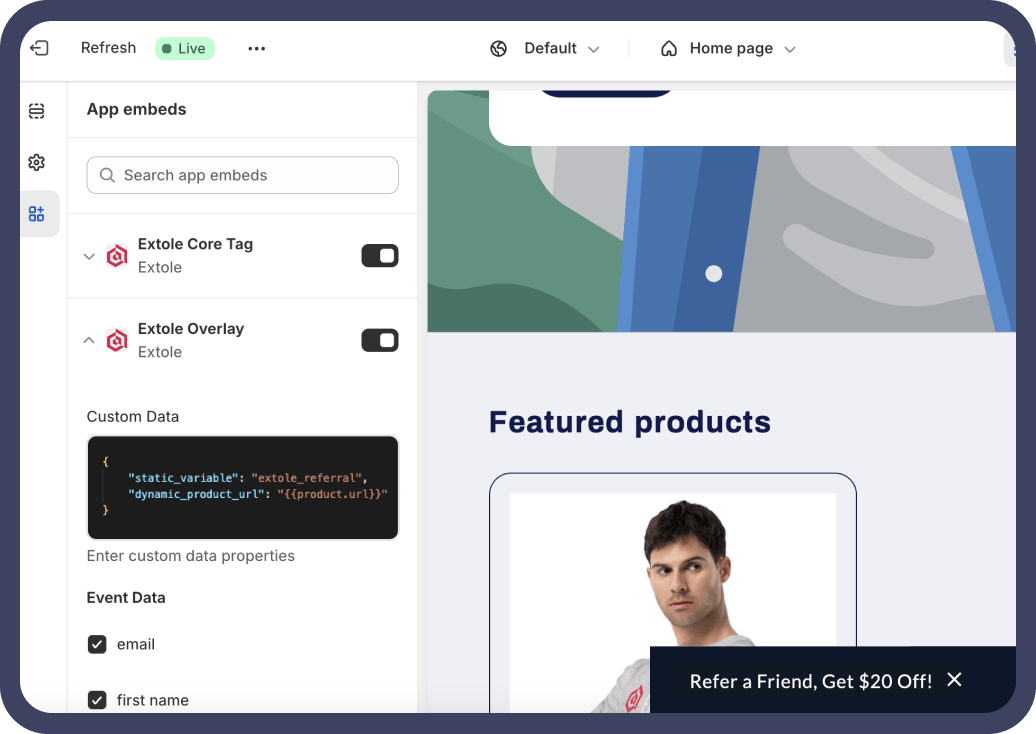
Extole integrates with Shopify to power embedded e-commerce referrals you can control from your Shopify dashboard.
Before beginning the integration, three things need to be in place:
- Extole’s Shopify App—The integration begins by installing Extole’s app directly from the Shopify App Store. This is the foundation of both the Shopify Plus and Hydrogen integration paths.
- A long-lived access token—Shopify uses Extole’s authenticated REST APIs to power reward delivery and event tracking. You’ll generate a long-lived access token inside Extole’s Security Center and connect it to your Shopify environment during setup.
- A branded program domain—Your referral program runs under a branded domain (for example, refer.yourbrand.com) rather than a generic Extole URL. This domain needs to be configured in your Extole account before the integration is complete, and Shopify’s CDN domain (extensions.shopifycdn.com) must be whitelisted in your branded program domain settings so that Shopify-served content can communicate with Extole.
Shopify Plus
For Shopify Plus merchants running traditional storefronts, the integration connects Extole directly to your storefront and checkout experiences. Once the app is installed and configured, you can place referral CTAs and program experiences at targeted points throughout your store — product pages, cart, post-purchase, account dashboard — and track customer activity in real time.
Reward delivery runs through Shopify Discounts. When a qualifying referral is completed, Extole automatically generates and delivers a unique Shopify discount code to the advocate — no manual fulfillment required. The entire loop from referral share to reward delivery is automated.
Shopify Hydrogen
For Shopify Plus brands running headless storefronts on Hydrogen — Shopify’s official framework for custom frontend builds — Extole provides a dedicated integration path with the same app-based foundation. The Hydrogen integration allows you to surface referral program experiences at checkout and throughout your custom storefront, track customer activity in real time, and deliver rewards via Shopify Discounts, all within a headless architecture.
The prerequisites are identical to the Shopify Plus integration:
- Install the Extole app
- Generate a long-lived access token
- Configure your branded program domain and whitelist the Shopify CDN domain.
- Implement integration within your Hydrogen storefront.
Automated Discount Code Generation
Across both integration paths, reward fulfillment works the same way: Extole calls Shopify’s Discounts API to generate unique discount codes when qualifying referral events occur. Advocates receive their reward automatically via email, SMS, or directly within the program experience, all without any manual work from your team. This automation is what makes referral programs viable at scale, where manual reward management would quickly become unworkable.
For the complete technical implementation details, see Extole’s Shopify Plus documentation and Shopify Hydrogen documentation.
Choosing the Right e-Commerce Referral Platform for Your Shopify Store
The Shopify App Store has dozens of referral apps. Most are designed for small or mid-sized brands looking for fast, low-complexity setup. For Shopify Plus retailers running high-volume programs, the right choice looks different. Here’s what to evaluate:
Shopify Integration Depth
Not all referral platforms integrate with Shopify the same way. The questions to ask:
- Does the platform support automated discount code generation via Shopify’s API, or does reward delivery require manual work?
- Can the platform receive server-side purchase events from Shopify webhooks, or is it entirely dependent on browser-side firing (which can be blocked or missed)?
- Is Shopify Hydrogen supported for headless builds?
- Does the integration support Shopify Plus features like Script Tags and multiple storefronts?
Braze and ESP Integration
If you’re using Braze, Attentive, or another email/SMS platform, your referral software should integrate directly with it to send referral prompts and updates. The ability to embed referral CTAs into existing Braze canvases, pass referral data back to Braze as custom properties, and use referral behavior to trigger or suppress campaigns is a significant capability gap between enterprise platforms and lightweight apps.
Reward Flexibility
Shopify brands need reward options that align with their products and customer base. The minimum requirements for enterprise use:
- Two-sided rewards (both advocate and friend receive something)
- Discount codes (percentage off, fixed amount, free product)
- Store credit and gift card options
- Tiered rewards (larger incentive after X referrals)
- SKU-specific or category-specific incentives
Basic referral apps often support only simple discount code rewards. If your program needs any complexity beyond that, you’ll hit limitations quickly.
A/B Testing
As noted above, if you can’t test reward values, messaging, and placement independently, you can’t optimize. Ask any vendor specifically what their A/B testing infrastructure looks like and whether tests can be run without engineering involvement.
Analytics and Attribution
You need to be able to answer: how many new customers came from referrals this month? What’s the conversion rate on referred friends? What’s the AOV of referred customers versus non-referred? Which advocates are driving the most revenue? A platform without robust attribution and reporting leaves you flying blind on program performance.
Fraud Detection
For high-volume programs, ask specifically: what fraud controls are in place? How does the platform detect duplicate accounts or self-referrals? Can rewards be held pending review?
Implementation Support
Lightweight Shopify apps are designed for self-serve setup. Enterprise referral platforms come with implementation support in the form of a team that guides you through integration, helps you configure your program, and stays engaged after launch. For Shopify Plus brands running complex programs, that support is worth paying for.
Program Design: What High-Performing Shopify Referral Programs Have in Common
Program design — the decisions about rewards, placement, messaging, and structure — drives referral performance just as much as the underlying technology.
Go Beyond Simple Rewarding
Rewards are at the heart of any referral program, so finding the right reward structure is key. For shoppers, this is often what distinguishes a truly worthwhile program from a forgettable one. Here’s what the data says on what rewards perform best:
- 53% of consumers value special discounts and promos in their rewards programs
- 58% of consumers value redeemable points as part of their retail rewards programs. This makes solutions like Extole’s Reward Bank, a reward for action extension, highly effective.
- 89% of Gen Z and 87% of millennials in one study reported a willingness to share personal information for the purpose of powering tailored offers or experiences.
With these statistics in mind, retailers should build a rewarding experience that goes beyond the simple “Give $20, Get $20” model, and incorporate engaging tactics like short-term reward bursts, rewards for completing key actions that can be accumulated and redeemed at will, and tiered or targeted rewards that motivate your most engaged customers to keep earning.
A/B testing is also a valuable tool for determining what rewards perform best for different audience segments.
Reward Value Should Be Tied to AOV
Your ideal core reward value often depends on your average order value and margin structure. A rough rule of thumb: the combined value of both sides of the reward (advocate + friend) should be meaningful relative to your AOV, but not so high that it attracts reward-seekers rather than genuine customers. For most e-commerce brands, a combined reward value of 15–25% of AOV is a reasonable starting point for testing.
Promotion Is as Important as the Reward
A referral program that customers never see doesn’t perform. The highest-converting placement points for Shopify brands are:
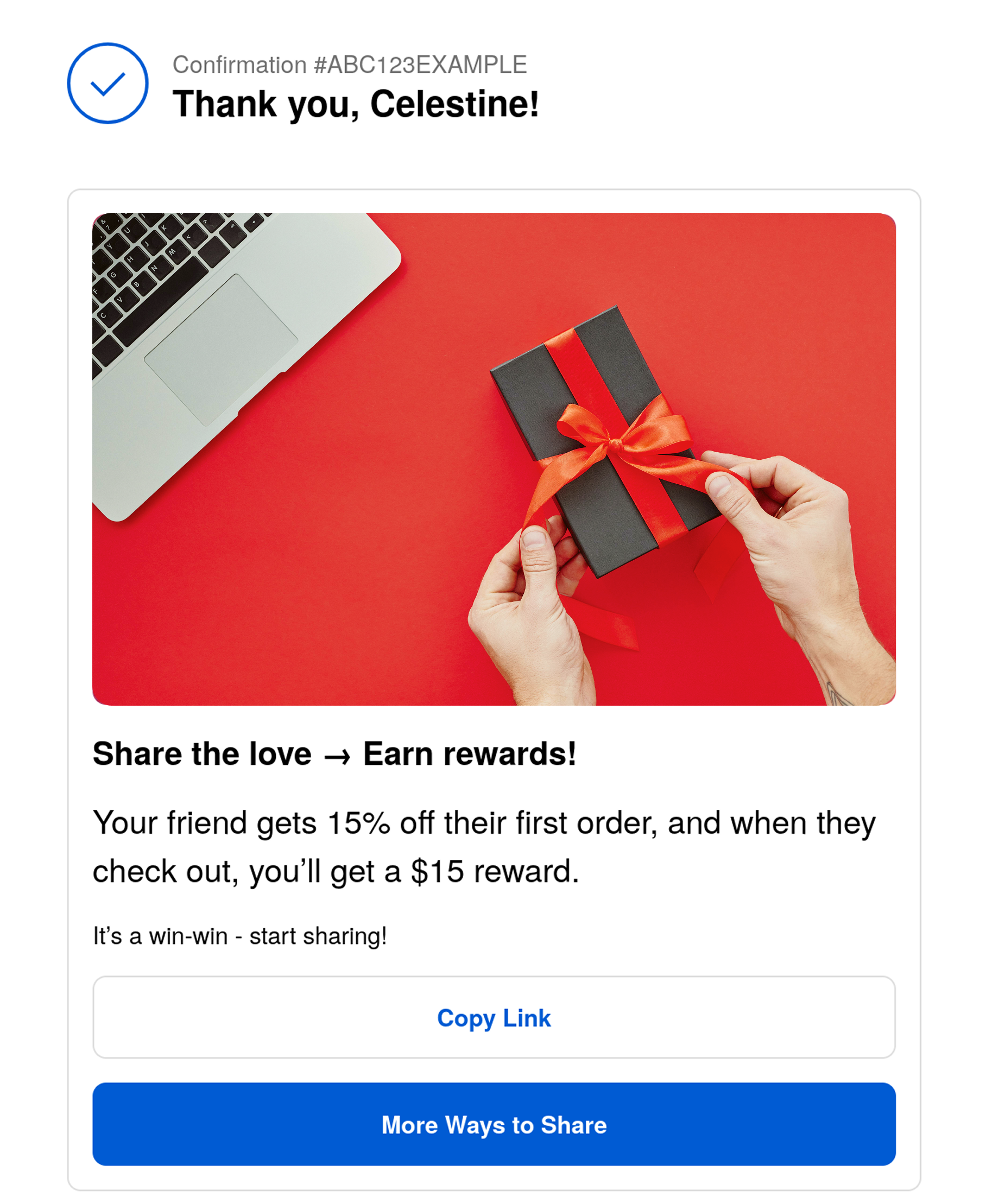
- Post-purchase (order confirmation page)—The moment of highest satisfaction. This is the most natural moment to ask customers to share.
- Post-purchase email—The order confirmation email has among the highest open rates of any marketing email. A referral CTA embedded in this email reaches customers while the experience is still fresh.
- Account dashboard—For brands with customer accounts, the account portal is a persistent referral touchpoint that customers return to repeatedly.
- Product pages and cart—For brands with highly shareable products, embedding a referral prompt on product pages or in the cart experience can surface the program earlier in the purchase cycle.
- Email/SMS flows—Win-back campaigns, loyalty anniversary emails, and post-purchase review request flows are all natural homes for a referral CTA. Customers who just left a 5-star review are prime candidates.
Make Sharing Easy Across Channels
Your customers share differently. Some prefer texting a link directly. Some will post on Instagram. Some will copy a code into a group chat. Your referral program should support multiple share mechanisms, including:
- Unique referral link
- Shareable code
- Social share buttons (Facebook, WhatsApp, Instagram)
- SMS
Use Segmentation to Target Your Best Advocates
Not all customers are equally likely to refer. Customers who have made multiple purchases, left positive reviews, or opened recent emails are much more likely to share than first-time buyers who haven’t engaged since their initial purchase. Extole’s audience segmentation tools let you identify your highest-potential advocates and promote the referral program specifically to them.
Run Seasonal Campaigns and Sweepstakes
An always-on referral program is the foundation, but seasonal campaigns can significantly boost participation. Holiday “Drop-a-Hint” campaigns, summer reward bursts, and time-limited sweepstakes where referrals earn entries can drive spikes in sharing activity and keep customers engaged year-round. Extole supports multiple program types running simultaneously: Your evergreen refer-a-friend program can run alongside a holiday sweepstakes or a tiered challenge without conflict.

Shopify’s Built-In Tools That Drive e-Commerce Referrals
Shopify has several native features that complement a referral program and are worth understanding as part of your overall growth strategy.
Shopify Discounts
Shopify’s native discount infrastructure powers rewards for referral platforms. Understanding the structure of Shopify discount codes — how price rules work, how codes are scoped, and the limitations — helps your team configure Extole’s reward delivery correctly.
Shopify Flow (Shopify Plus)
Shopify Plus merchants have access to Flow, Shopify’s automation tool. While referral program logic lives in Extole, Flow can be used to trigger complementary actions — for example, tagging a customer as “referred” in Shopify after they complete a purchase, or sending a specific post-purchase email sequence to referred customers via your ESP.
Shopify Analytics
Shopify’s native analytics give you order-level data, including discount code usage. You can use this to cross-reference referral performance data from Extole with Shopify’s revenue reporting.
Shopify Email and Shopify Inbox
For brands using Shopify’s native email or chat tools, referral CTAs can be embedded in Shopify Email templates as a complement to your dedicated ESP campaigns.
Customer Accounts
Shopify’s customer account system is a natural home for a referral dashboard — a persistent place where customers can see their referral link, track their rewards, and share with friends. Extole’s account portal experience can be embedded within or alongside Shopify customer accounts.
Getting Started: What to Expect from an Extole Integration on Shopify
The Extole implementation process for Shopify Plus brands typically involves four phases:
- Integration setup (1 week)—During this initial setup phase, you’ll create a program domain where all your referral and offer program events live, as well as an access token so Shopify can use Extole’s APIs. You only need to generate these once, and both can be done easily inside your Extole account, with no engineering work required. For liquid Shopify themes, this is also where you will generate marketing tags to promote referrals throughout your Shopify store.
- Program configuration (1-2 weeks)—Extole’s team works with you to configure your program — reward structure, eligibility rules, fraud controls, email templates, and program creative. Pre-built referral templates significantly accelerate this phase.
- Creative and content review (1 week)—All customer-facing program content — referral landing page, share messages, reward notification emails — is reviewed and approved by your team before launch.
- Launch and optimization (ongoing)—After launch, Extole’s account management team works with you on an ongoing basis to review program performance, run A/B tests, and identify optimization opportunities.
Most Shopify Plus brands are live within 4–6 weeks of starting the integration process.
Planning to invest in referral software in 2026? Review our checklist for buyers:

Conclusion: Next Steps for Shopify Retailers
The gap between Shopify e-commerce brands with well-built referral programs and those without is a real competitive advantage. Customers acquired through referrals are higher-quality, lower-cost, and more likely to refer again.
The key is choosing a platform built for the complexity your programs will eventually require — one that integrates deeply with Shopify and your existing marketing stack, gives you the testing and optimization infrastructure to improve over time, and handles fraud and attribution in ways that lightweight Shopify apps simply can’t.
If you’re a Shopify Plus retailer looking to build or improve a referral program, schedule a demo to see how Extole works for Shopify e-commerce brands.
Frequently Asked Questions About Shopify Referral Solutions
Shopify retailers evaluating referral software often have questions about integrations,
discount code automation, attribution, fraud prevention, and what separates enterprise
referral platforms from lightweight app store tools. These FAQs cover the most common
questions ecommerce teams ask when comparing Shopify referral solutions.
What is a Shopify referral solution?
A Shopify referral solution is software that helps ecommerce brands turn customer
word-of-mouth into a measurable acquisition channel. It gives existing customers a way
to share referral links or codes with friends, tracks referred purchases, and automates
rewards for both the advocate and the new customer.
Why do Shopify retailers need referral software?
Shopify retailers are already operating in the digital channels where referral programs
perform best. Customers are already sharing products with friends, and referral software
helps formalize that behavior, attribute conversions correctly, and reward advocates in a
scalable way. For many ecommerce brands, referral marketing can become a high-ROI
customer acquisition channel.
What should retailers look for in Shopify referral solutions?
Retailers should look for deep Shopify integration, automated discount code generation,
flexible reward options, strong analytics, omnichannel attribution, fraud prevention, and
A/B testing capabilities. For enterprise retailers, implementation support and integrations
with platforms like Braze, Attentive, and other email or SMS tools are also important.
How do enterprise Shopify referral solutions differ from basic referral apps?
Enterprise Shopify referral solutions are built for higher volume, more complex customer
journeys, and broader channel orchestration. Compared with lightweight referral apps,
enterprise platforms typically offer stronger attribution, more advanced fraud controls,
structured testing, more flexible rewards, and better support for Shopify Plus and
headless storefronts.
Do Shopify referral platforms support automated discount code generation?
Yes. Strong Shopify referral software should automate reward fulfillment by generating
unique discount codes directly in Shopify when a qualifying referral happens. This helps
brands avoid manual reward fulfillment, reduce operational overhead, and maintain a
cleaner reward process at scale.
Can Shopify referral software work with Shopify Plus?
Yes. Shopify Plus retailers often need referral solutions that can support more advanced
use cases, including flexible placement across the storefront, post-purchase experiences,
customer accounts, and more sophisticated reward logic. Shopify Plus brands also benefit
from stronger implementation support and optimization infrastructure.
Do Shopify referral solutions support Shopify Hydrogen or headless ecommerce builds?
Some do. Retailers running headless storefronts on Shopify Hydrogen should confirm that
a referral platform supports Hydrogen specifically, not just traditional Shopify themes.
This is especially important for brands that want referral experiences and tracking to work
consistently throughout a custom frontend architecture.
What reward types work best in Shopify referral programs?
The best reward structure depends on your average order value, margins, and customer
behavior. Common options include two-sided discounts, fixed-amount rewards, percentage
discounts, store credit, gift cards, tiered rewards, and category-specific incentives.
High-performing programs often test multiple reward formats instead of relying on a
single static offer.
Where should referral offers appear in the Shopify customer journey?
The highest-value placements often include the post-purchase confirmation page,
post-purchase email, account dashboard, product pages, cart, and lifecycle email or SMS
flows. These placements help retailers promote referral at moments when customer
satisfaction and engagement are highest.
Can Shopify referral solutions integrate with email and SMS platforms?
Yes. Many retailers get more value from referral when it is embedded into their broader
retention and lifecycle marketing strategy. Integrations with platforms like Braze,
Attentive, and similar email or SMS systems can make it easier to promote referral
through post-purchase flows, loyalty campaigns, win-back messages, and VIP outreach.
Why is omnichannel attribution important in referral software for retailers?
Retail customers often discover and buy across multiple devices and channels. A shopper
might receive a referral link by text, browse on mobile, and purchase later on desktop.
Omnichannel attribution helps ensure the advocate still gets credit, so retailers can
measure referral performance more accurately and avoid undercounting referred revenue.
How do Shopify referral solutions help prevent referral fraud?
Referral fraud can include self-referrals, duplicate accounts, and link farming. Strong
platforms use controls such as device fingerprinting, IP-based anomaly detection,
configurable quality rules, and review workflows to help prevent invalid rewards from
being issued.
Do retailers need A/B testing in referral software?
Yes. A/B testing is important because reward value, messaging, creative, and placement
all influence program performance. Retailers that can test these elements systematically
are better positioned to improve conversion rates, increase sharing, and grow referral
revenue over time.
What makes a high-performing referral program for Shopify retailers?
High-performing Shopify referral programs usually combine the right reward structure,
strong promotion across the customer journey, easy sharing options, accurate attribution,
fraud prevention, and ongoing optimization. They also target high-potential advocates
instead of treating every customer the same.
How long does it take to launch a Shopify referral program?
Launch timing depends on the complexity of the integration and program design, but
enterprise Shopify retailers often go live after setup, configuration, creative review,
and launch planning are completed. Brands evaluating software should ask vendors about
both implementation timelines and post-launch optimization support.